News

Cracking the Code
Nick Pinkerton
IF YOU WERE TO DEVISE the platonic ideal of a pre-Code movie it would probably look quite a bit like Tay Garnett’s 1930 barrelhouse melodrama Her Man, which transposes the “Frankie and Johnnie” story—then recently recorded to great acclaim by musician Jimmie Rodgers—to a blind tiger in Havana, where the dregs of all nations congregate and copulate.
While Film Forum programmer Bruce Goldstein has made pre-Code his bailiwick for years, the Museum of Modern Art gets to plant their flag on Her Man, which will be playing at Fifty-Third Street along with four other Garnett films and Chester Erskine and John H. Auer’s 1936 Frankie and Johnnie, one of the last screen appearances of the troubled, wrenchingly emotive torch singer Helen Morgan.
Her Man establishes itself as something special from the opening credits—written in wet sand on the beach, with each “card” washed away by the surf—and within the first reel vaults into the sublime. After being turned away from US soil and hopes for a new life, tattered and used-up b-girl Annie (Marjorie Rambeau, in a performance that anticipates Susan Tyrell’s Fat City souse) heads back to Havana. Her walk to her accustomed haunt, the Thalia, is recorded in a tracking shot which follows her down the teeming main drag of the pleasure district, ducking heedless horse carts and familiarly making her way through the rowdy, brawling polyglot masses literally tumbling out of every saloon door. The concert of casual gestural precision and individual detail that Garnett gets from his crowd scenes, here as throughout, is electrifying, while the fluidity of the camera movement and dense tapestry of sound give the lie to the persistent idea that cinema’s transformation into an audio-visual art sent it back to the drawing board.
The real focus of the story isn’t Annie, who soon settles back into a fog of blue ruin and self-pity, but one of her younger coworkers, Frankie (Helen Twelvetrees), who is handled by slickster pimp Johnnie (Ricardo Cortez), and has somehow retained a glimmer of goodness despite making her living picking pockets while batting her doll eyes at suckers and spoon-feeding them sob stories. The trouble begins when she levels her eyes at Dan Keefe (Phillips Holmes), an angelically handsome sailor on a stopover whose only possessions are a medal attesting to uncommon valor, a striped sweater that gradually disintegrates through the course of the movie, and a dream of clean living.
Moviegoers acquainted with the period will undoubtedly find some key elements of Her Man familiar. The setting and setup are reminiscent of Josef von Sternberg’s The Docks of New York (1928); Dan and Frankie’s rebirth before a church altar might very well have been cadged by Leo McCarey for his Love Affairnine years later; and the raucous, reckless shore-leave atmosphere is akin to that of Raoul Walsh’s Sailor’s Luck (1933)—though it should be said that Her Man deserves extra marks for sozzled sordidness, and the climactic barroom brawl contains back-breaking suicidal stuntwork of a sort rarely seen outside of 1980s Golden Harvest productions. And gourmands of period argot would be hard-pressed to find a more sumptuous spread, starting with Frankie’s sisterly admonition “You got the heebies bad, grab yourself a coupla snorts.”
The reappearance of Her Man was precipitated by the discovery of the original camera negative in the Library of Congress’s Columbia Pictures collection—the 4K DCP playing MoMA is the result of a collaboration between Sony Pictures and the Film Foundation. To see the film in its original format in New York you’d have to have been around in 1967. In Andrew Sarris’s The American Cinema, published the following year, the author, still fresh from seeing Cinémathèque Français loan prints of Her Man and The Spieler (1928), defined Garnett’s personality as that of “a rowdy vaudevillian.” To this I might add that he shows significant control in the midst of knockabout chaos, and that Her Man exhibits several resourceful examples of visual synecdoche, such as representing Annie’s return to Havana entirely with shots of her legs and worn-down pumps, swabbed out of the way on the ship’s deck like so much refuse.
Garnett was a former gag man for Hal Roach and Mack Sennett, and that pedigree is certainly more evident here than in what is his best-known work, the 1946 film of James M. Cain’s The Postman Always Rings Twice. MoMA’s program offers a selection of rare, lesser-known Garnett titles. Most of these come from the late 1920s and early ’30s—including a single screening of The Spieler in the late afternoon on Thursday—with 1953’s Main Street to Broadway an outlier. Outside of Her Man, the rest of the program is 35 mm: theMain Street print from the MoMA archive; The Spieler in what adjunct curator Dave Kehr describes as a “gorgeous” print from the Eastman Museum; and Celebrity (1928), “an on-the-fly ‘restoration’ composed of reels from two incomplete prints, one from MoMA and one from the Library of Congress.” It’s more Garnett than has been seen in one place in many moons, and if it’s even still a thin slice to evaluate a fifty-year career on, there’s no denying that Her Man is a rolling, heaving, helluva a good time—and that’s on the level.
“Her Man: A Forgotten Masterwork in Context” runs March 29 to April 4 at the Museum of Modern Art in New York.
SHORTLIST ANNOUNCED FOR FOCAL FOOTAGE AWARDS 2016
London, UK – 8th March 2016 - FOCAL International, the Federation of Commercial Audio-visual Libraries, today announced its shortlist for the thirteenth annual FOCAL International Awards, to be presented in association with AP Archive on 26th May 2016 at the Lancaster London Hotel, hosted by Kate Adie, the former Chief News Correspondent for the BBC and current presenter of From Our Own Correspondent on BBC Radio 4. The FOCAL International Awards celebrate the best use of footage across all variety of genres and media platforms, as well as those who preserve, restore and ensure that archival footage remains a vital resource to the global production community.
Sixteen awards will be presented in total, including the Lifetime Achievement Award, won this year by renowned film preservationist Robert Gitt.
This year’s finalists were drawn from a large, diverse and international pool of nominees, with a strong showing from the United States and Europe. The United States is also well represented in the Footage Researcher of the Year nominations and this was from a very strong field of 12 entries in that category.
“We are delighted with both the international turnout and the prevalence in this year’s shortlist of so many highly-acclaimed archive-based films such as Amy, Cobain and Best of Enemies,” said event organizer Julie Lewis.
The FOCAL International Awards also honour the work of archival researchers, footage archivists and film preservationists, with this year’s Lifetime achievement award going to legendary film preservationist Robert Gitt.In a career spanning more than fifty years, Robert Gitt has gained an international reputation as one of the foremost experts in the preservation and restoration of motion pictures. In addition, Gitt will deliver the Jane Mercer Memorial Lecture on May 24th in the lead up to the FOCAL International Awards ceremony.
Tickets for the Gala Awards Ceremony 26th May are now on sale, so you'll need to hurry if you want to book a table http://www.focalint.org/focal-international-awards
SPONSORSHIP OPPORTUNITIES: Please talk with ANNE JOHNSON at FOCAL International if you are interested info@focalint.org +44 (0)20 7663 8090
FINAL NOMINATIONS - FOCAL INTERNATIONAL AWARDS in association with AP ARCHIVE:
Best Use of Footage in a History Production
Sponsored by Getty Images / BBC Motion Gallery
• A German Youth (Une Jeunesse Allemande) – Local Films (France)
• Every Face Has a Name - Auto Images (Sweden)
• Red Gold (L'Or Rouge) - Vivement Lundi ! (France)
Best Use of Footage in a Current Affairs Production
Sponsored by Bloomberg Content Service
• Clockwork Climate - Artline Films (France)
• India's Daughter - Assassin Films (UK)
• The Queen of Ireland - Blinder Films (Ireland)
Best Use of Footage in a Factual Production
Sponsored by Bridgeman Footage
• Best of Enemies - Magnolia Pictures (USA)
• The Black Panthers: Vanguard of the Revolution - Firelight Films, Inc (USA)
• The Killing Fields of Dr. Haing S. Ngor - DeepFocus Productions, Inc (USA)
Best Use of Footage in an Entertainment Production
Sponsored by FremantleMedia Archive
• A City Dreaming - Indie Movie Company for BBC NI (UK)
• Best of Enemies - Tremolo Productions / Magnolia Pictures (USA)
• Children Over Time - RAI Radiotelevisione Italiana (Italy)
Best Use of Footage in an Arts Production
Sponsor sought
• Arena: Night and Day - BBC (UK)
• By Sidney Lumet - RatPac Documentary Films / Augusta Films / Thirteen Productions LLC's (USA)
• Imagine: The Ecstasy of Wilko Johnson - Essential Nitrate Limited / BBC (UK)
Best Use of Footage in a Music Production
Sponsored by Shutterstock
• Amy - On The Corner (UK)
• Cobain: Montage of Heck - End of Movie, LLC (USA)
• Eurovision at 60 - BBC Entertainment Production (UK)
Best Use of Sports Footage
Sponsored by ITV Sport Archive
• Building Jerusalem - New Black Films Limited (UK)
• Free to Run - Yuzu Productions (France) Point Prod (Switzerland) and Eklektik Productions (Belgium)
• I Believe In Miracles - Baby Cow Productions and Spool Films (UK)
Best Use of Footage in an Advert or Short Production
Sponsor sought
• Gatorade 'Heritage' - Stalkr/TBWA/Chiat/Day (USA)
• Lenor 'Odes to Clothes: Marvellous Scarf' - The Director Studio for Grey Düsseldorf (UK/Germany)
• MTV 'Tagline Here' - Stalkr/ Ghost Robot (USA)
Best use of Footage about the Natural World
Sponsor sought
• Beasts Behaving Badly - Barcroft Productions (UK)
• The Nature of Things: Jellyfish Rule! - CBC (Canada)
• Wild 24 - NHNZ / Nat Geo Wild (New Zealand)
Best Use of Footage on non-Television Platforms
Sponsor sought
• Bitter Lake - BBC Productions (UK)
• Britain on Film - BFI (UK)
• The Beatles 1+ Video Collection - Apple Corps Limited (UK)
Best Use of Footage in a Cinema Release
Sponsored by British Pathé
• Amy - On The Corner (UK)
• Cobain: Montage of Heck - End of Movie, LLC (USA)
• Free to Run - Yuzu Productions (France) Point Prod (Switzerland) and Eklektik Productions (Belgium)
Best Archive Restoration / Preservation Project or Title
Sponsor sought
• La Noire de... Restored by The Film Foundation's World Cinema Project in collaboration with the Sembene Estate, INA, Eclair Laboratories and Centre National de Cinematographie. Restoration carried out at Cineteca di Bologna - (USA/Italy)
• Marius – Compagnie Méditerranéenne de Films-MPC and the Cinémathèque française, with the support of the CNC, the Franco-American Cultural Fund DGA-MPA -SACEM-WGAW, the help of ARTE France Cinema Department, the Audiovisual Archives of Monaco, and the participation of SOGEDA Monaco / Digimage Classics (France)
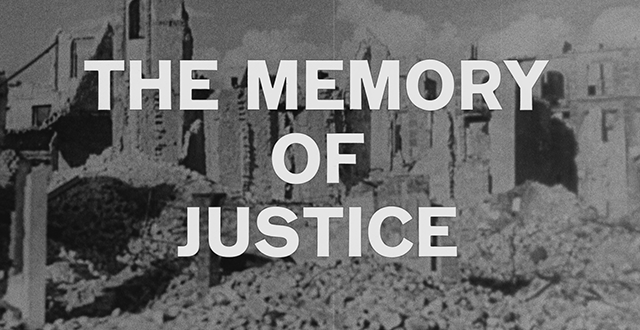
• The Memory of Justice – The Film Foundation / Academy Film Archive (USA)
• Varieté - Friedrich-Wilhelm-Murnau-Stiftung and Filmarchiv Austria (Germany/Austria)
The Jane Mercer Footage Researcher of the Year Award
Sponsored by AP Archive
• Colleen Cavanaugh Anthony, Alexis Owens (Stalkr/USA) - Transparent Srs 2 Titles;
The Big Short; MTV Tagline Here
• Jessica Berman-Bogdan (USA) - Cobain: Montage of Heck; Narcos
• Prudence Arndt, Deborah Ford Gribaudi (USA/France) - Free To Run
Footage Employee of the Year
Sponsored by Creative Skillset
• Tim Emblem English (BBC Studios and Post Production)
• Paul Davis (Getty Images)
• Bhirel Wilson (BBC Motion Gallery / Getty Images)
Footage Library of the Year
Sponsored by Bonded Services
• Historic Films Archive
• Huntley Film Archives
• Kinolibrary
Lifetime Achievement Award
A gift of the FOCAL International Executive
Robert Gitt
To see the CREDITS and SYNOPSES of the final nominations and the full list of 191 submissions to the FOCAL International Awards from 17 countries click on the relevant category drop-down list through the hyperlinks above or via http://www.focalint.org/focal-international-awards/2016/the-focal-international-awards-2016
ABOUT FOCAL INTERNATIONAL
The Federation of Commercial Audiovisual Libraries International is a professional not-for-profit trade association formed in 1985. It is fully established as one of the leading voices in the industry, with a membership of over 300 international companies and individuals.
Its purpose is to facilitate the use of library footage, images, stills and audio in all forms of media production; promote its members - libraries selling content plus those whose serve the industry; provide a platform for members to promote themselves and their interests; encourage good practise in the research, licensing, copyright clearance and use of footage; support, promote and educate on the need to preserve and restore footage and content; act as an information resource for the footage and content industry; offer training in key skills and in the broader appreciation of the footage and content industry.
www.focalint.org

NFAI workshop to help preserve India’s cinematic heritage
Shoumojit Banerjee
The National Film Archive of India, the country’s largest film archive and custodian of the Indian film heritage, is conducting a workshop in film preservation and restoration to help conserve the nation’s cinematic legacy.
The NFAI, in collaboration with the International Federation of Film Archives (FIAF) and the Film Heritage Foundation (FHF), will conduct a one-of-a-kind 10-day workshop beginning February 26 titled ‘Film preservation & restoration workshop India 2016’.
The objective of this programme is not only to augment the infrastructure and capacity of the NFAI but also to build an indigenous resource of film archivists and restorers who can work towards saving India’s cinematic heritage.
“There is no culture of ‘preserving’ in this country. The first week-long workshop held in Mumbai in the Films’ Division last year was a resounding success. Fortunately, the fact that film preservation is a specialised field and that we need to build an indigenous resource of trained archivists that can take this movement forward is a fact that is gradually impressing itself,” said Shivendra Singh Dungarpur, who heads the FHF, commenting on the genesis of the workshop.
The ten-day advanced course has been specially designed by David Walsh, head of the FIAF Technical Commission, with focus on intensive practical training in current film preservation and archival practices.
“Since Indian cinema has been gaining attention of researchers and scholars across the world, it becomes imperative that these aspects along with meta-data management be made ready as per universal standards,” Mr. Dungarpur said.
The workshop will be an advanced course with emphasis on documentation, cataloguing, projection system and the importance of preserving films in celluloid and digital.
Lectures and practical sessions in the workshop will be conducted by leading archivists and restorers from preeminent film institutions in the world such as the George Eastman Museum, Selznick School of Film Preservation, FIAF and L’Immagine Ritrovata, and is supported by Martin Scorsese’s ‘The Film Foundation’s World Cinema Project’. There will be equal emphasis on preservation of heritage on celluloid format along with digitisation, said NFAI Director Prakash Magdum.
“Even though India is one of the largest producers of movies in the world, general awareness about film preservation is abysmal and is not looked as a career option. So, through this workshop, we will showcase the use of the latest technological advances that will prolong the life of celluloid film,” Mr Magdum said. The NFAI in recent years has carried out digitisation of nearly 500 films and the restoration of 300 more a few years back.
BERLINALE CLASSICS: PRESENTING SIX NEWLY-RESTORED FILMS FROM GERMANY, JAPAN, TAIWAN AND THE USA
Berlinale Classics
The Berlinale Classics series of the 66th Berlin International Film Festival will present premieres of six films, two German and four international productions, five of them world premieres.
Heiner Carow’s semi-autobiographical film Die Russen kommen (The Russians are Coming, GDR, 1968) is set in the waning days of World War II. For 16-year-old Günter Walcher, the defeat of the Nazis is a catastrophe that brings his world to collapse. But a film about fascism without anti-fascist heroes was a no-go for the East German regime, and the film was banned before completion. In 1987, it was reconstructed based on a severely damaged work print, as only small sections of the negative had survived. Digital technology has now enabled the DEFA Foundation, in cooperation with the German Federal Film Archive, to produce a new restoration by combining footage from disparate source elements that varied in optical quality.
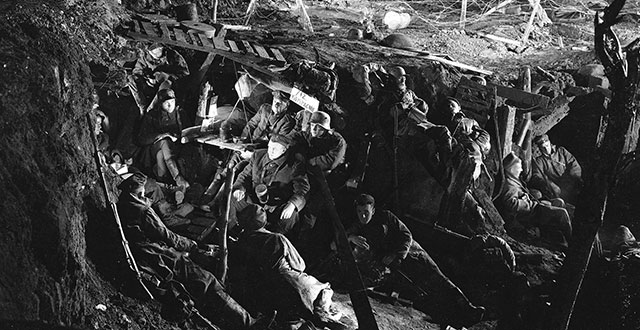
The American film The Road Back directed by James Whale in 1937, also references a slice of German history. It is based on the eponymous Erich Maria Remarque novel about four German infantrymen who face a difficult road back to civilian life. In 1939, after protests from Germany, Universal Studios re-edited the film without consulting the director. The festival is showing a reconstruction of James Whale’s original 1937 theatrical release version, preserved by the Library of Congress in collaboration with NBCUniversal and Martin Scorsese's The Film Foundation. David Stenn and the UCLA Film & Television Archive provided skills and film footage.
“It’s particularly fascinating that two of the Berlinale Classics movies are closely linked to censorship in Germany's past", says Rainer Rother, section head for the Retrospective and artistic director of the Stiftung Deutsche Kinemathek foundation. Heiner Carow’s The Russians are Coming is among the films that were banned or censored in East Germany for political reasons. We are showing several of those films in this year's Retrospective "Germany 1966. Redefining Cinema". Another illuminating example of the interference to which those films were subjected is The Road Back. It is proof that the political influence of the Nazi authorities was not restricted to Germany.“
With the digitally restored version of Bakushu (Early Summer), Berlinale Classics is once again presenting a work by Japanese master director Yasujiro Ozu. The 1951 film, about a young woman named Noriko whose family is trying to marry her off, is one of Ozu’s later works. Noriko is played by Ozu’s favourite actress, Setsuko Hara, who died in September 2015 at the age of 95. The 4K digital restoration project by the well-known Japanese production company Shochiku was led by Ozu’s former assistant cameraman Takashi Kawamata and cinematographer Masashi Chikamori, known for his work as a DP on Yoji Yamada films.
Also from Asia is the Taiwanese film Ni Luo He Nu Er (Daughter of the Nile) by Huo Hsiao-hsien, made in 1987. It is the director’s first film focusing on a female protagonist, and also notable for its depiction of Taipei in the 1980s. The digital restoration was based on the original 35 mm negative and was done under the aegis of the Taiwan Film Institute with Chen Huai-en, the film's cinematographer, overseeing the 4K-restoration.
Another digitally restored film from the US in the Berlinale Classics section is John Huston’s classic Fat City, made in 1972 with virtuoso cinematography by DP Conrad Hall. It features Jeff Bridges in one of his first screen roles, as the talented boxer Ernie. The melancholy tone of the film is set by Kris Kristofferson’s hit “Help Me Make It Through the Night". The film was restored from an original 35 mm negative and digitised in 4K by Sony Pictures, under the supervision of Grover Crisp.
The Berlinale Classics section will open with Fritz Lang’s 1921 silent film classic Der müde Tod(Destiny). The digitally restored version, made possible by the Friedrich Wilhelm Murnau Foundation, will premiere on February 12, 2016 in the Friedrichstadtpalast Friedrichstadtpalast (see press release from Dec 2, 2015). Broadcasters ZDF / ARTE commissioned new music for the film from composer Cornelius Schwehr, which will be played by the Radio Symphony Orchestra Berlin (RSB), with conductor Frank Strobel at the podium.
Berlinale Classics programme
Bakushu (Early Summer)
By Yasujiro Ozu, Japan, 1951
Monday Feb. 15, 2016, CinemaxX 8
World premiere of the digitally restored version in 4K DCP
Fat City
By John Huston, USA, 1972
Friday Feb. 19, 2016, CinemaxX 8
International premiere of the digitally restored version in 4K DCP
Der müde Tod (Destiny)
By Fritz Lang, Germany, 1921
Friday Feb. 12, 2016, Friedrichstadtpalast
World premiere of the digitally restored version in 2K DCP
Music by the Radio Symphony Orchestra Berlin (RSB) conducted by Frank Strobel
Ni Luo He Nu Er (Daughter of the Nile)
By Hou Hsiao-hsien, Taiwan, 1987
Sunday Feb. 14, 2016, CinemaxX 8
World premiere of the digitally restored version in 4K DCP
The Road Back
By James Whale, USA, 1937
Tuesday Feb. 16, 2016, CinemaxX 8
World premiere of the restored version in 35mm
Die Russen kommen (The Russians are Coming)
By Heiner Carow, East Germany, 1968/1987
Saturday Feb. 13, 2016, CinemaxX 8
World premiere of the digitally restored version in 2K DCP
https://www.berlinale.de/en/presse/pressemitteilungen/retrospektive/retro-presse-detail_30933.html