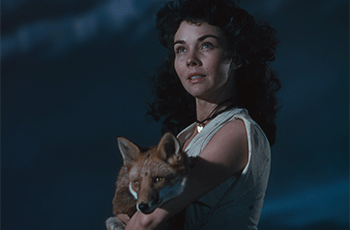
Restored by The Film Foundation’s World Cinema Project and Fundación Televisa at L’Immagine Ritrovata in collaboration with Filmoteca UNAM and in association with Televisa S. de R.L. de C.V. Funding provided by the Golden Globe Foundation. Special thanks to Guillermo del Toro.

Martin Scorsese created the World Cinema Project (WCP) in 2007 recognizing the urgent need to preserve, restore, and provide access to films from around the world. To date, 72 films from Africa, Asia, Eastern Europe, Central America, South America, and the Middle East have been restored, preserved, and exhibited for global audiences. As part of the WCP, the African Film Heritage Project (AFHP) was launched in 2017 in partnership with the Pan African Federation of Filmmakers (FEPACI) and UNESCO, in collaboration with Cineteca di Bologna, to preserve the legacy of African cinema. The WCP also supports Restoration Film Schools, intensive, results-oriented workshops allowing students and professionals to learn the art and science of film restoration and preservation. Titles are available for exhibition rental by clicking "Book This Film."
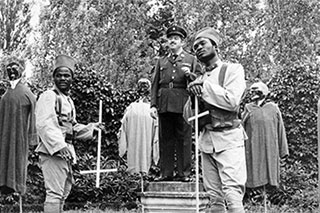
MAURITANIA | 1970
SOLEIL Ô
OH, SUN!
Director: Med Hondo
WRITTEN BY: Med Hondo
EDITING: Michèle Masnier, Clément Menuet
DIRECTOR OF PHOTOGRAPHY: François Catonné, Jean-Claude Rahaga
STARRING: Robert Liensol, Théo Légitimus, Gabriel Glissand, Mabousso Lô, Alfred Anou, Les Black Echos, Ambroise M’Bia, Akonio Dolo
COUNTRY OF PRODUCTION: Mauritania
LANGUAGE: French with English subtitles
COLOR INFO: Black and White
RUNNING TIME: 98 minutes
PRODUCTION COMPANY: Grey Films, Shango Films
SET DESIGNER: Med Hondo
Restored by Cineteca di Bologna at L’Immagine Ritrovata laboratory in collaboration with Med Hondo. Restoration funded by the Hobson/Lucas Family Foundation and The Film Foundation’s World Cinema Project.
This restoration is part of the African Film Heritage Project, an initiative created by The Film Foundation’s World Cinema Project, the Pan African Federation of Filmmakers and UNESCO – in collaboration with Cineteca di Bologna – to help locate, restore, and disseminate African cinema.
I identify with Med Hondo in terms of anger and I share his obsession with history and self-reliance.
--Haile Gerima
When I wrote my script I did not have an audience in mind, I was living in France and experiencing what being a minority felt like. I had to yell and free myself. Writing the script of Soleil Ô was an authentic act of rage and liberation.
Once the script was ready, I gathered a crew of technicians and a team of African actors. Then I went to see some film processing companies and told them “Here I am, I don’t have a penny in my pocket but I want to make a film, let me have some raw film, I will reimburse you on an installment plan, and if I fail to do so you can put me in jail.” They agreed. The film cost $ 30,000 and it took almost two years to shoot because my actors were not always available.
There are different perceptions of an image. Soleil Ô is crystal clear and is neither intellectual nor sophisticated. It has often happened that those who understood it best were illiterate. When it was shown in Algeria, because the audience was completely able to identify with the film, the proletarians explained it to the intellectuals.
My main character could be a garbage collector, a student, or a teacher. His status does not prevent him from being affected in the same manner by the general conditions of history within a racist society. To be a Black expatriate is an identity. Soleil Ô derives from the African oral tradition. It depicts a unique reality. There is no dichotomy between style and content; here it is the content which imposes a style. I wanted to describe several people through one person instead of using a group of people. In my country, when people talk about a specific issue, they may digress and come back to their initial topic. Black cultures have a syntax which has nothing to do with Cartesian logic or that of other civilizations.
-- Med Hondo
NOTES ON THE RESTORATION:
The restoration of Soleil Ô was made possible through the use of a 16mm reversal print, and 16mm and 35mm dupe negatives deposited by Med Hondo at Ciné-Archives, the audiovisual archive of the French Communist Party, in Paris.
The reversal print was scanned at 4K and digital restoration eliminated dirt, scratches and mold. Despite excellent photographic quality overall, a few sequences appear slightly out-of-focus; this is true to the original cinematography.
A vintage 35mm print preserved at the Harvard Film Archive was used as a reference. Color grading was supervised by cinematographer François Catonné.
The original 16mm magnetic tracks were used for the audio restoration. After digitization, the soundtrack was cleaned and background noise reduction eliminated all noticeable wear marks; particular attention was devoted to the specific dynamics and features of the original soundtrack, namely percussion and chants. Reel 4 as well as the main and end titles were missing, so these were restored using the original 35mm soundtrack. The latter was also used to replace the 16mm mag tracks in the parts where the mix differed slightly from the vintage 35mm print.
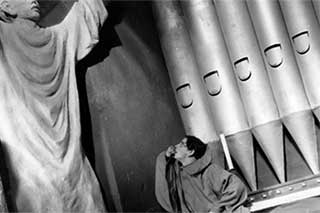
MEXICO | 1934
DOS MONJES
TWO MONKS
Director: Juan Bustillo Oro
WRITTEN BY: Juan Bustillo Oro, José Manuel Cordero
EDITING: Juan Bustillo Oro
DIRECTOR OF PHOTOGRAPHY: Agustín Jiménez
PRODUCER: José San Vicente, Manuel San Vicente
MUSICAL DIRECTOR: Max Urban
PRODUCTION DESIGN: Mariano Rodríguez, Granada, Carlos Toussaint
STARRING: Víctor Urruchúa, Carlos Villatoro, Beltrán de Heredia, Emma Roldán, Magda Haller
COUNTRY OF PRODUCTION: Mexico
LANGUAGE: Spanish with English subtitles
COLOR INFO: Black and White
RUNNING TIME: 85 minutes
PRODUCTION COMPANY: Proa Films
PRODUCER: José San Vicente, Manuel San Vicente
Restored by The Film Foundation’s World Cinema Project at L’immagine Ritrovata laboratory in collaboration with Filmoteca de la UNAM and Cinémathèque française. Restoration funded by the Material World Charitable Foundation.
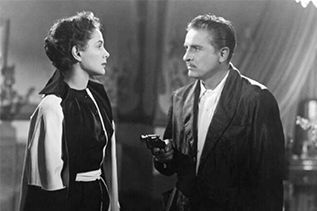
MEXICO | 1953
ÉL
Director: Luis Buñuel
WRITTEN BY: Luis Buñuel, Luis Alcoriza
EDITING: Carlos Savage
DIRECTOR OF PHOTOGRAPHY: Gabriel Figueroa
ADAPTED BY: Luis Buñuel, Luis Alcoriza
PRODUCER: Óscar Dancigers
PRODUCTION DESIGN: Edward Fitzgerald
STARRING: Arturo de Córdova, Delia Garcés, Aurora Walker, Carlos Martínez Baena, Manuel Dondé, Rafael Banquell, Fernando Casanova, Luis Beristáin
COUNTRY OF PRODUCTION: Mexico
LANGUAGE: Spanish with English subtitles
COLOR INFO: Black and White
RUNNING TIME: 82 minutes
PRODUCER: Óscar Dancigers
Restored by The Film Foundation's World Cinema Project, Les Films du Camélia and Cineteca di Bologna at L'Immagine Ritrovata Laboratory, with the support of OCS and in association with Películas y Videos Internacionales.
Special thanks to Guillermo del Toro.
Funding provided by the Material World Foundation.
NOTES ON THE RESTORATION:
The 4K restoration used the dupe positive preserved by Películas y Videos Internacionales at the Filmoteca de la UNAM, where the scan was performed. Color grading was supervised by Gabriel Figueroa Flores.
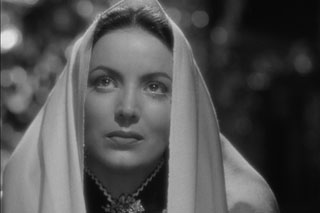
MEXICO | 1946
ENAMORADA
Director: Emilio Fernández
WRITTEN BY: Iñigo de Martino, Emilio Fernández
EDITING: Gloria Schoemann
DIRECTOR OF PHOTOGRAPHY: Gabriel Figueroa
PRODUCER: Benito Alazraki Franco
MUSICAL DIRECTOR: Eduardo Hernández Moncada
SOUND: José B. Carles
ART DIRECTOR: Manuel Parra
PRODUCTION DESIGN: Manuel Fontanals
STARRING: María Félix, Pedro Armendáriz, Fernando Fernández
COUNTRY OF PRODUCTION: Mexico
LANGUAGE: Spanish with English subtitles
COLOR INFO: Black and White
RUNNING TIME: 99 minutes
PRODUCTION COMPANY: Panamerican Films, S.A.
SET DESIGNER: Manuel Parra
PRODUCER: Benito Alazraki Franco
Restored by UCLA Film & Television Archive and The Film Foundation’s World Cinema Project in collaboration with Fundacion Televisa AC and Filmoteca de la UNAM. Restoration funded by the Material World Charitable Foundation.
NOTES ON THE RESTORATION:
The 4K restoration of ENAMORADA utilized the original 35mm nitrate picture and track negatives stored by Televisa at Filmoteca de la UNAM in Mexico City. A 35mm nitrate print, provided by Filmoteca de la UNAM, was also used as a secondary element. 4K scanning and restoration was completed by Roundabout Entertainment and the audio restoration was completed by Audio Mechanics.
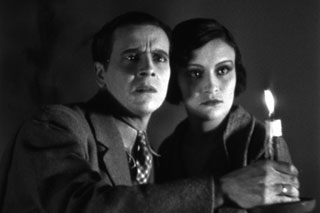
MEXICO | 1934
FANTASMA DEL CONVENTO, EL
Director: Fernando de Fuentes
WRITTEN BY: Jorge Bezet, Fernando de Fuentes, Juan Bustillo Oro
DIRECTOR OF PHOTOGRAPHY: Ross Fisher
PRODUCER: Jorge Bezet
STARRING: Enrique del Campo, Marte Roel, Carlos Villatoro, Paco Martínez, Victorio Blanco
COUNTRY OF PRODUCTION: Mexico
LANGUAGE: Spanish with English subtitles
COLOR INFO: Black and White
RUNNING TIME: 85 minutes
PRODUCER: Jorge Bezet
Restored by UCLA Film & Television Archive and The Film Foundation’s World Cinema Project, with funding provided by the George Lucas Family Foundation.
NOTES ON THE RESTORATION:
Preserved from the 35mm nitrate picture and track negatives and a 16mm acetate composite dupe negative. Laboratory services by Fotokem, Roundabout Entertainment, Inc., Audio Mechanics, DJ Audio, Inc., Titrafilm Paris. Special thanks to Viviana Garcia Besne, Permanencia Voluntaria; Albino Álvarez Gómez, Filmoteca de la UNAM.
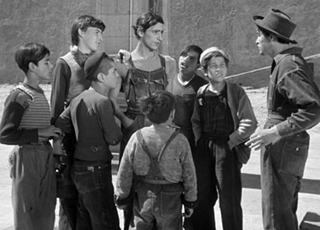
MEXICO | 1950
LOS OLVIDADOS
Director: Luis Buñuel
WRITTEN BY: Luis Buñuel, Luis Alcorira
EDITING: Carlos Savage
DIRECTOR OF PHOTOGRAPHY: Gabriel Figueroa
PRODUCER: Óscar Dancigers, Sergio Kogan, Jaime A. Menasce
MUSICAL DIRECTOR: Rodolfo Halffter
STARRING: Estela Inda, Miguel Inclán, Alfonso Mejía, Roberto Cobo, Alma Delia Fuentes
COUNTRY OF PRODUCTION: Mexico
LANGUAGE: Spanish with English subtitles
COLOR INFO: B&W
RUNNING TIME: 80 minutes
PRODUCER: Óscar Dancigers, Sergio Kogan, Jaime A. Menasce
Restored by The Film Foundation's World Cinema Project in collaboration with Fundacion Televisa, Televisa, Cineteca Nacional Mexico, and Filmoteca de la UNAM.
Restoration funding provided by The Material World Foundation.
NOTES ON THE RESTORATION:
LOS OLVIDADOS was restored in 4K from the camera and soundtrack nitrate negatives preserved at Filmoteca de la UNAM. The film reels were scanned at UNAM laboratory and the soundtrack was digitized by Cineteca Nacional de México.
Special thanks to Gabriel Figueroa Flores for his supervision of the grading process.
The restoration work was carried out by L'Immagine Ritrovata in 2019.
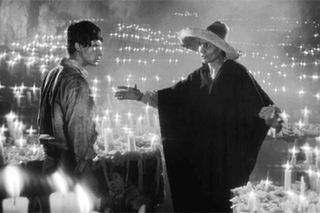
MEXICO | 1960
MACARIO
Director: Roberto Gavaldón
EDITING: Gloria Schoemann
DIRECTOR OF PHOTOGRAPHY: Gabriel Figueroa
ADAPTED BY: Emilio Carballido, Roberto Gavaldón
MUSICAL DIRECTOR: Raúl Lavista
STARRING: Ignacio López Tarso, Pina Pellicer, Enrique Lucero, José Gálvez, José Luis Jiménez, Mario Alberto Rodríguez, Consuelo Frank
COUNTRY OF PRODUCTION: Mexico
LANGUAGE: Spanish with English subtitles
COLOR INFO: B&W
RUNNING TIME: 91 minutes
NOTES ON THE RESTORATION:
MACARIO was restored from the original camera and sound negatives preserved at Televisa. Image scanning at 4K resolution and audio digitization work was completed by Filmoteca UNAM. Restoration of the picture and sound was carried out at L'Immagine Ritrovata in 2023.
Special thanks to Gabriel Figueroa Flores for supervising the color grading.
MEXICO | 1943
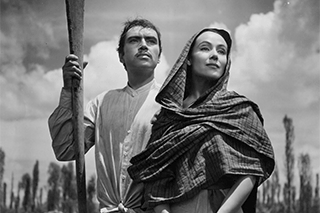
MARÍA CANDELARIA
Director: Emilio Fernández
WRITTEN BY: Emilio Fernández, Mauricio Magdaleno
EDITING: Jorge Bustos, Gloria Schoemann
DIRECTOR OF PHOTOGRAPHY: Gabriel Figueroa
PRODUCER: Agustín J. Fink
STARRING: Dolores Del Río, Pedro Armendáriz, Alberto Galán, Margarita Cortés, Miguel Inclán
COUNTRY OF PRODUCTION: Mexico
LANGUAGE: Spanish with English subtitles
COLOR INFO: Black and White
RUNNING TIME: 102 minutes
PRODUCER: Agustín J. Fink
Restored in 2024 by the Academy Film Archive, TelevisaUnivision, Filmoteca UNAM, and The Film Foundation's World Cinema Project. Restoration funding provided by the Material World Foundation.
MEXICO | 1967
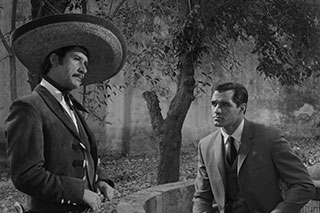
PEDRO PÁRAMO
Director: Carlos Velo
WRITTEN BY: Carlos Fuentes, Carlos Velo, Manuel Barbachano Ponce
EDITING: Gloria Schoemann
DIRECTOR OF PHOTOGRAPHY: Gabriel Figueroa
PRODUCER: Federico Amérigo, Felipe Subervielle
STARRING: John Gavin, Ignacio López Tarso, Pilar Pellicer, Julissa, Graciela Doring, Carlos Fernández
COUNTRY OF PRODUCTION: Mexico
LANGUAGE: Spanish with English subtitles
COLOR INFO: Black and White
RUNNING TIME: 105 minutes
PRODUCER: Federico Amérigo, Felipe Subervielle
Restored by The Film Foundation’s World Cinema Project and Fundación Televisa at L’Immagine Ritrovata in collaboration with Filmoteca UNAM and in association with Televisa S. de R.L. de C.V. Funding provided by The Material World Foundation.
NOTES ON THE RESTORATION:
PEDRO PÁRAMO was restored in 4K from the original camera and soundtrack negatives preserved at Televisa. Image scanning and audio digitization work was completed by Filmoteca UNAM. Special thanks to Gabriel Figueroa Flores. Restoration work was carried out at L'Immagine Ritrovata laboratory and completed in 2025.
MEXICO | 1936
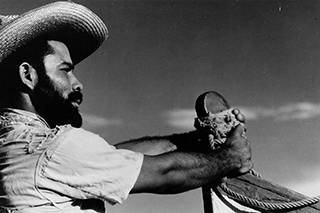
REDES
Director: Fred Zinnemann, Emilio Gómez Muriel
WRITTEN BY: Agustín Velázquez Chávez, Paul Strand
EDITING: Emilio Gómez Muriel, Gunther von Fritsch
DIRECTOR OF PHOTOGRAPHY: Paul Strand
ADAPTED BY: Emilio Gómez Muriel, Fred Zinnemann and Henwar Rodakiewicz
MUSICAL DIRECTOR: Silvestre Revueltas
SOUND: Roberto, Joselito Rodriguez
FROM: Cinemateca de la UNAM, Mexico
STARRING: Silvio Hernández (Miro), David Valle González (Monopolist), Rafael Hinojosa (Politician), Antonio Lara (El Zurdo), Miguel Figueroa and native fishermen
COUNTRY OF PRODUCTION: Mexico
LANGUAGE: Spanish with French and English subtitles
COLOR INFO: Black and White
RUNNING TIME: 61 minutes
PRODUCTION COMPANY: Secretaría de Educación Pública
Restored in 2009 by Cineteca di Bologna/L'Immagine Ritrovata laboratory, in association with The Film Foundation’s World Cinema Project and Filmoteca de la UNAM. Restoration funded by Armani, Cartier, Qatar Airways and Qatar Museum Authority.
The film – the first (and last) of its kind – was expected to play a small part in the Government’s plan to educate millions of illiterate citizens throughout the enormous country and bring them out of their isolation. […] The picture was to be made for the Federal Department of Fine Arts, headed by composer Carlos Chávez. The producer would be Paul Strand. […] We had recruited practically all ‘actors’ from among the local fishermen, who needed to do no more than be themselves. They were splendid and loyal friends, and working with them was a joy. In addition to acting, they carried all the equipment, rowed the boats and did a multitude of other jobs, earning more money than ever before – forty-five cents per day, per man – and enjoying themselves hugely. […] I’m told that some years later the Nazis found the negative in Paris and burned it. A few prints still exist. –Fred Zinnemann
NOTES ON THE RESTORATION:
The restoration of Redes used the best surviving materials, namely a 35mm safety duplicate negative and a positive print preserved at the Filmoteca de la UNAM in Mexico. The digital restoration produced a new 35mm internegative.
Image: © Courtesy of Filmoteca de la UNAM
MOROCCO | 1978
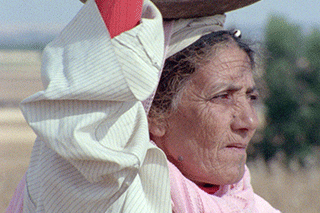
ALYAM, ALYAM
Director: Ahmed El Maanouni
WRITTEN BY: Ahmed El Maanouni
EDITING: Martine Chicot
DIRECTOR OF PHOTOGRAPHY: Ahmed El Maanouni
MUSICAL DIRECTOR: Nass el Ghiwane
SOUND: Ricardo Castro
PRODUCTION DESIGN: Rabii Films
STARRING: Toualàa villagers (Oulad Ziane) in the Casablanca region, and in particular: Abdelwahad and his family, Tobi, Afandi Redouane and Ben Brahim
COUNTRY OF PRODUCTION: Morocco
LANGUAGE: Arabic, French with English subtitles
COLOR INFO: B&W
RUNNING TIME: 90 minutes
Restored by Cineteca di Bologna/L’Immagine Ritrovata laboratory, in association with Ahmed El Maanouni. Restoration funded by The Film Foundation’s World Cinema Project.
Alyam, Alyam is a film about shattered dreams and the circumstances leading up to that point; about the shaking of the traditional social structure; about the strength born of desperation and the unrelenting dissipation of lost generations. This is stressed from the first notes of the opening music, by the strangely empty building frame that is slowly filled with people, by the village space, by the silence of the wandering woman who smokes, until the last shot of the film, when a crowd appears from behind a deserted hill. The dreams of a society growing smaller, unable to hold on to the resources that could help it survive, are mirrored by the mother’s helpless prayer, “I need your shadow, I need your light, I need your face.”
I simply wanted to show the farmers’ faces, to honor their sounds and their images, their silences and their words, and that’s why I chose not to interfere and to opt for deliberately restrained composition, movement and mise-enscène. I tried to minimize the camera’s ability to distort, make a point, or discriminate. I wanted each aspect to be presented equally. I did not look for spectacular beauty, but made an effort to let the imagery of the rural world speak through abstraction and silence.
Almost 40 years later, when I watch Alyam, Alyam again, I am still comfortable with my aesthetic choices and my intuitions, but I cannot avoid noticing how, from beginning to end – from the opening shots with the blood shed by the camels, to the crowd of peasants appearing from behind the hills – it all seemed to presage the current tragedy experienced by the thousands whose broken dreams lie at the bottom of the Mediterranean, on which the voice of Nass El Ghiwane’s Larbi Batma seems to strangely resonate: “Alyam, Alyam, oh, those were the days! Why are you crossed? Who changed your course? You were once sweet like milk, now you’re bitter. I love all men as if they were my brothers. My brothers have crushed me. I will silence my pain and let my love be loud.”- Ahmed El Maanouni
NOTES ON THE RESTORATION:
The restoration of Alyam, Alyam used the 16mm A/B rolls original camera and sound negatives preserved at Eclair Laboratories, where the 4K scan was performed. Restoration - carried out at Cineteca di Bologna/L’Immagine Ritrovata - succeeded in stabilizing the image and bringing the original chromatic qualities to light. Director Ahmed El Maanouni supervised the color grading process and approved the final restoration.
MOROCCO | 1981
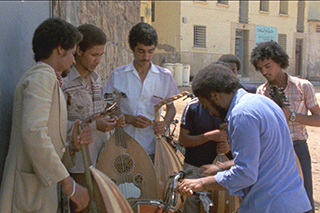
TRANCES
EL HAL
Director: Ahmed El Maanouni
WRITTEN BY: Ahmed El Maanouni
EDITING: Jean-Claude Bonfanti
DIRECTOR OF PHOTOGRAPHY: Ahmed El Maanouni
PRODUCER: Izza Génini
MUSICAL DIRECTOR: Nass El Ghiwane
STARRING: Nass El Ghiwane
COUNTRY OF PRODUCTION: Morocco
LANGUAGE: Arabic
COLOR INFO: Color
RUNNING TIME: 87 minutes
PRODUCTION COMPANY: OHRA/SOGEAV
PRODUCER: Izza Génini
Restored in 2007 by Cineteca di Bologna/L’Immagine Ritrovata laboratory, in association with The Film Foundation’s World Cinema Project, Ahmed El-Maanouni, and Izza Genini. Restoration funded by Armani, Cartier, Qatar Airways and Qatar Museum Authority.
“It was in 1981 while I was editing a film, The King of Comedy. We worked at night so no one would call us on the telephone and I would have television on, and one channel in New York at the time, around 2 or 3 in the morning, was showing a film called Transes. It repeated all night and it repeated many nights. And it had commercials in it, but it didn’t matter. So I became passionate about this music that I heard and I saw also the way the film was made, the concert that was photographed and the effect of the music on the audience at the concert. I tracked down the music and eventually it became my inspiration for many of the designs and construction of my film The Last Temptation of Christ. […] And I think the group was singing damnation: their people, their beliefs, their sufferings and their prayers all came through their singing. And I think the film is beautifully made by Ahmed El Maanouni; it’s been an obsession of mine since 1981 and that is why we are inaugurating the Foundation with Trances.” –Martin Scorsese, May 2007
NOTES ON THE RESTORATION:
Notes on the restoration
The restoration of Trances used the original 16mm camera and sound negative provided by producer Izza Génini. The camera negative was restored both photochemically and digitally and blown-up to 35mm format. The sound negative was restored to Dolby SR and digital.
Image: © Courtesy of OHRA-Izza Génini