News
Once Maligned, Now Restored, Otto Preminger’s ‘Saint Joan’ Returns to Its Original Glory
Jim Hemphill
A new restoration undertaken by the Academy Film Archive and Martin Scorsese's Film Foundation will screen this weekend at the 12th annual Cinema Revival Film Festival.
This weekend the Wexner Center in Columbus, Ohio is holding its 12th annual Cinema Revival Film Festival devoted to celebrating the art and practice of film restoration and preservation. As always, the lineup is stacked with recent restorations of classics from around the globe, from New Hollywood favorites like Bob Rafelson‘s “Five Easy Pieces” and Steven Spielberg‘s “Close Encounters of the Third Kind” to Erich von Stroheim’s long lost silent treasure “Queen Kelly” and Leobardo López Arretche’s landmark 1968 documentary “El Grito.” There’s also a program devoted to animation treasures, a rare 3D screening of the Jerry Lewis comedy “Money From Home,” and a presentation of “Ghost in the Shell” director Mamoru Oshii’s live-action debut “The Red Spectacles.”
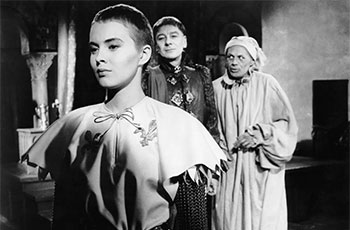
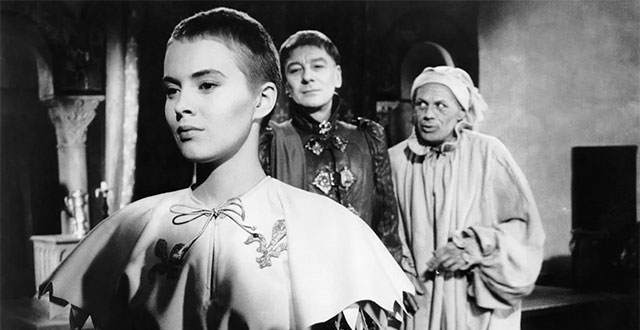
One of the best films screening at this year’s festival is also one that was seriously underrated and misunderstood by both the critics and the public when it first appeared in 1957. “Saint Joan” was producer-director Otto Preminger‘s adaptation of George Bernard Shaw’s 1923 play about the life of Joan of Arc, a play the extremely well-read Preminger considered to be “the greatest masterpiece ever written for the theater.” To adapt the play, Preminger hired the great screenwriter and novelist Graham Greene, who Preminger felt would add meaning and emotional investment to the project given his Catholicism.
“Saint Joan” had long been an object of fascination and desire for Preminger, who was in a position to acquire it after finding success as an independent filmmaker with movies like “The Moon is Blue” and “The Man With the Golden Arm” in the years following his era at Fox as a sturdy contract director. A study in opposing values that pits Joan’s unwavering faith against men in power who range from the sympathetic to the willfully ignorant, “Saint Joan” was both a departure for Preminger in its abstraction (he was already moving toward the kind of realist-based location shooting that would characterize his best films like “Anatomy of a Murder” and “Advise and Consent”) and perfectly in his wheelhouse as an exploration of moral gray areas.
To find his leading lady, Preminger embarked on a nationwide search and personally auditioned thousands of would-be Joans before landing on Jean Seberg, an 18-year old from Iowa whose acting experience was limited to high school plays. Casting the unknown Seberg, who would become exalted by cinephiles for her role in Jean-Luc Godard’s “Breathless” (as well as her performance in Preminger’s next film, “Bonjour Tristesse”), had several benefits for Preminger.
The first was a bonanza of free publicity, as the American press ate up Seberg’s Cinderella story and covered it relentlessly in the months leading up to the film’s release. The second benefit was an aesthetic one: casting a young and inexperienced American opposite mostly established British thespians (Preminger produced the film in England under the Eady plan, which provided government subsidies for films using British artists) added to Joan’s sense of isolation, oppression, and exclusion.

That alienation was increased by Preminger’s treatment of Seberg on set, which was, by all first-hand accounts, extremely harsh. Costars like Richard Widmark, who gives one of the weirdest but most interesting performances of his career as The Dauphin, were deeply troubled by Preminger’s constant verbal abuse of Seberg; then there was an accident on set (which seems to have horrified even the tyrannical Preminger) that led to Seberg getting badly burned during the climax where she is burned at the stake.
Seberg suffered through it all only to be excoriated by the press, along with Preminger, when “Saint Joan” was released. As is so often the case, there was a backlash against all the pre-release hype; the free publicity generated by Preminger’s talent search had turned rancid by the time the film finally arrived. The reviews were cruel, and extremely unfair given that Seberg’s performance is not only not the disaster the critics claimed it to be, it’s one that often rises to the level of greatness in Seberg’s ability to convey Joan’s blinding, relentless sense of commitment to her cause — and her genuine shock and horror when she learns it is not enough to spare her.
The deep sadness of Seberg’s performance, which probably feels more resonant now knowing how tragically her life ended, is unblinkingly captured by Preminger’s objective camera and cutting, which rarely editorialize. Preminger was the least manipulative of all classical Hollywood directors (one reason why he probably thrived as an independent once he broke free of the more rigid visual language directors needed to practice while under contract to the studios), a filmmaker who avoided close-ups and who kept dramatic emphasis to a minimum in his editing.
The technique was inextricably bound to his worldview as a prober and philosopher uncommitted to absolute truth or inflexible morality; in Preminger’s world, there are always myriad perspectives that, if not equally valid, are equally considered. Thus even Joan of Arc doesn’t get the heroic treatment she would if “Saint Joan” had been directed by someone like Cecil B. DeMille, or even John Ford or Michael Curtiz. Preminger’s restraint has made the film age well, but in its time it probably kept audiences from recognizing the power of Seberg’s work and the audacity of Preminger’s experimental storytelling.

The restoration of “Saint Joan” that will be screening at Cinema Revival this Sunday has been making the rounds of festivals and museums since making its world premiere at the Academy Museum a little over a year ago, and it’s a revelation for those of us who fell in love with the film via the murky home video copies that have been circulating since the early 1990s. Even Cassie Blake, the film preservationist at the Academy Film Archive who oversaw the restoration, was surprised by the film’s elegance and beauty.
“The cinematography and production design are stunning and lush in a way I had not realized until working on the restoration, despite having seen the film before,” Blake told IndieWire. “Much of the discussion surrounding the film focuses on its performances, but it’s worth paying attention to the aesthetic details as well.” Perhaps the most valuable effect of the restoration is to see how Preminger’s aesthetic concerns intersect with Seberg’s performance for maximum impact; his framing of her most exhausted, pleading moments makes “Saint Joan” as much a documentary of its lead actor’s exasperation as a biography of Joan of Arc, and the details in her expressions and gestures are more deeply, vividly felt in the 4K restoration.
Blake attributes the exquisite quality of the restoration to the superior source elements she had to work with, as the Academy possesses the original negative and optical soundtrack for “Saint Joan” as part of the Preminger Collection that Otto Preminger’s daughter Victoria donated to the archive in 2006. “Both were in beautiful condition for their age, free of any major deterioration or missing footage,” Blake said. “A restoration is often only as good as its source element, and the negative of ‘Saint Joan’ was up for the task.”
For the Academy’s restoration, the original 35mm picture negative was scanned at 4k and digitally restored in a 4k workflow. “A new 35mm track positive was produced from the 35mm optical track negative in order to provide optimal sound quality,” Blake said. “Once created, the new track positive was subsequently captured and restored. Once the digital restoration was complete, we recorded a 35mm filmout and new track negative. An answer print and release prints were created photochemically, rounding out the restoration process.”
The new print and DCP of “Saint Joan” take their place in the Academy’s archive alongside many other important Preminger prints donated by Victoria, who was a strong advocate for the restoration of “Saint Joan” before she passed away in 2024. Blake notes that the Academy also holds a rare 35mm print of the film’s trailer, in which Preminger appears and announces the selection of Seberg in the title role. “Watching the director announce his quest to find his next star cements the idea that Seberg was truly plucked from obscurity to carry this film,” Blake said. “As someone who deeply appreciates Seberg’s subsequent work in ‘Breathless’ and ‘Bonjour Tristesse,’ it’s fascinating to watch these significant facets of her trajectory.”
“Saint Joan” will screen at the Wexner Center’s Cinema Revival Film Festival on Sunday, March 1. It was restored by the Academy Film Archive and The Film Foundation, with funding provided by the Hobson/Lucas Family Foundation.
Guillermo del Toro and Martin Scorsese Celebrate the ‘Extraordinary Artistry’ of ‘The Greatest Story Ever Told’
Jim Hemphill
The directors paid tribute to George Stevens' 1965 biblical epic before the Academy Museum's premiere of a new restoration overseen by Amazon MGM Studios and Scorsese's Film Foundation.
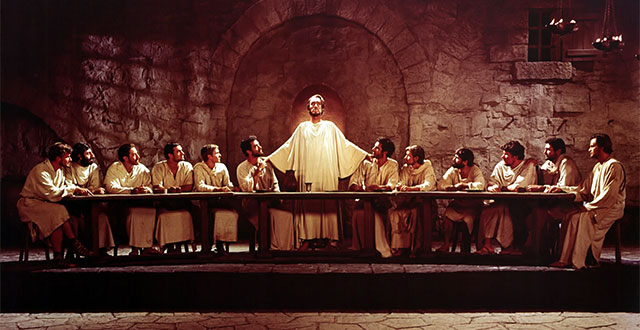
On Saturday, the Academy Museum of Motion Pictures in Los Angeles presented the world premiere of a new 4K restoration of George Stevens‘ “The Greatest Story Ever Told” (1965), one of the most ambitious and experimental of all Hollywood epics. Director Martin Scorsese, whose Film Foundation was instrumental in restoring the film (and whose “The Last Temptation of Christ” is the only biblical epic that rivals “The Greatest Story” in its audacity and complexity), provided a video introduction in which he celebrated Stevens’ masterpiece as the summation of his work.
“ The film was shot in Ultra Panavision 70 with lenses that yielded an aspect ratio of 2.76 to 1, and it was breathtaking,” Scorsese said. “But it wasn’t just the size of the image, it was the imprint of the man behind the camera who knew how to fill that frame, how to compose it. And composer seems like the right word to describe George Stevens and the extraordinary level of artistry he reached at that point in his life and career.”
Scorsese explained that when Stevens came back from World War II, his work took on a new sense of purpose and urgency in powerful works like “A Place in the Sun,” “Shane,” “Giant,” and “The Diary of Anne Frank.” “He began to pay very close attention to evil, to the greed and the hatred and the raw murderous violence that can overtake us all if we don’t all pay attention,” Scorsese said. “Those pictures are grand cinematic canvases, but they’re also urgent warnings to take care of our goodness and our love.”
Although Stevens was not a particularly religious man, he saw in Jesus Christ a way to explore those themes on their grandest scale. “‘The Greatest Story Ever Told’ is the summation,” Scorsese said. “It’s the final movement of Stevens’ multi-picture symphony. Stevens chose to enact the story on a scale of mythic grandeur and timeless immensity. This picture was years in the making at a cast of thousands.” It also felt of a piece with Stevens’ Westerns thanks to the unusual choices the director made when it came to locations.
“It was set against the backdrop of the American West in locations that we normally associate with Westerns,” Scorsese said. “Death Valley, Moab, Utah, Pyramid Lake in Nevada. It’s an extraordinary idea and it was really controversial because most biblical epics up to that time been shot somewhere near the Middle East or in the Middle East.” Scorsese noted that the film was part of a trend that included Nicolas Ray’s “King of Kings” and Pier Paolo Pasolini’s “The Gospel According to St. Matthew” that brought a new immediacy to the story of Jesus Christ. “They turned away from the conventions of the period.”
Scorsese added that the production encountered “one calamity after another” and ultimately didn’t fully realize Stevens’ vision. “ Nevertheless, Stevens put everything he had into the telling of the story of Jesus and you could feel it from the first frame to the last,” Scorsese said. “He wanted to embody the tragedy and the redemption of humanity on every level. In a way, his ambitions were so grand that it wasn’t possible to realize them fully, but the sheer intensity and artistry of the picture is moving all on its own. There’s nothing else quite like it.”

Stevens’ son, filmmaker George Stevens Jr., worked on the restoration with Amazon MGM Studios and the Film Foundation and appeared in person at the Academy Museum to introduce Guillermo del Toro, a lifelong Stevens enthusiast and Film Foundation board member who was present to deliver a 20-minute lecture on “The Greatest Story Ever Told” before the film. As a Catholic raised in Mexico, del Toro estimated that he had seen “The Greatest Story” over 20 times — and he sat with the audience in the Academy Museum to watch it again in its exquisite new restoration.
Del Toro provided rich historical context for the film, describing Stevens’ path through several epochs of filmmaking. “He lived through every era of cinema,” del Toro said before exploring Stevens’ innovations during the silent period, his wartime documentary work, his seminal post-war American epics, and the influence he had on the New Hollywood. This last topic was where del Toro’s lecture was most revelatory, as he explained why the perception of Stevens as a staid classical filmmaker is dead wrong, and that in fact Stevens was a modernist who influenced one of the most groundbreaking films of the 1960s, “Bonnie and Clyde.”
“I want to make the case today that this man influenced the New American Cinema,” del Toro said. “He influenced Martin Ritt, Warren Beatty, Terrence Malick and many more.” Del Toro gave the example of Warren Beatty studying the sound mix of “Shane” and applying its principles to the climactic shoot-out in “Bonnie and Clyde.” “Beatty was the first man that noticed ‘Shane’ was a modern film by a modern master. Stevens insisted that the percussion, the brutality of a gunshot overpowers with its violence, and Beatty understands that this is a bold decision, a bold technique.”
In discussing “The Greatest Story Ever Told,” del Toro insightfully drew parallels between Stevens’ age and our own, both in terms of world politics and upheaval in the film industry. “ His canvas became Ultra Panavision 70, with a spherical system that gave him extra space,” del Toro said. “When he shot this movie, there was a battle between TV and cinema — we’re there again — and the battle was how to get people into theaters. One of the things was spectacle. The larger formats were getting people into theaters, but very few directors really knew how to use it and how to use it expressively.”
Del Toro added that Stevens used the vast potential of the Ultra Panavision 70 frame as a tool to examine his themes with sweep and intensity. “You can find out more about an artist by their art than by sharing space and time with them,” del Toro said when explaining that “The Greatest Story Ever Told” expressed Stevens’ profoundly humanistic point of view. “This is a time and a generation that didn’t signal virtue, they practiced it. They didn’t tell you who they were, they demonstrated who they were.”

“The Greatest Story Ever Told” represented a demonstration of all that Stevens had learned and felt about good and evil since liberating Dachau concentration camp during his time in the service, an experience that informed the film he made right before “The Greatest Story Ever Told,” “The Diary of Anne Frank.” “One of the questions he was trying to grapple with was that no one group crucified Jesus,” del Toro said. “We all crucified Jesus. Stevens said there was no them, it was us.”
Yet for del Toro, what stands out about “The Greatest Story Ever Told” and the rest of Stevens’ body of work is its hopefulness and faith. “He realized that art and narrative have such a high calling to tell us what we are and who we are, and that compassion and decency are our superpowers,” del Toro said. “Don’t let them lie to you that hatred is our superpower. It diminishes us, and Stevens understood this.”
Stevens only made one film after “The Greatest Story Ever Told,” the Warren Beatty vehicle “The Only Game in Town,” which got made due to Beatty’s reverence for the master director. “What would George Stevens have done after this film if given another chance at the canvas he was grappling with?” del Toro asked before closing his lecture with the memory of watching “The Greatest Story Ever Told.” “If you grow up Mexican, every Easter you saw this movie. It’s Saturday, but let’s have Easter together.”
“The Greatest Story Ever Told” premiered at the Academy Museum of Motion Pictures, where Guillermo del Toro presented this year’s “George Stevens Lecture on Directing”— the museum’s ongoing lecture series about the art of filmmaking. For information on future museum events, visit their website.
Blu-ray Review: ‘Martin Scorsese’s World Cinema Project No. 5’ on the Criterion Collection
Jake Cole
Criterion offers another slew of neglected classics their much-deserved moment in the sun.
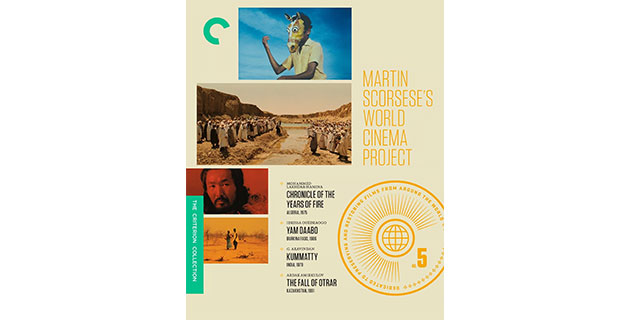
The Criterion Collection’s latest bundle of films restored by Martin Scorsese’s World Cinema Project is bookended by two of the largest spectacles in the series to date: Mohammed Lakhdar-Hamina’s Palme d’or-winning Chronicle of the Years of Fire, which reorients the visual language of a David Lean epic around the perspective of a colonized people, and Ardak Amirkulov’s The Fall of Otrar, which was made off and on for a period of years during the collapse of the Soviet Union.
Beginning in the lead-up to the Second World War and carrying through to the period of the postwar Algerian independence movement and eventual war, Chronicle of the Years of Fire centers its vast canvas on Ahmed (Yorgo Voyagis), who uproots his family from a drought-ravaged village to Algiers, where he becomes radicalized by the exploitation he suffers at the hands of French colonists. Lakhdar-Hamina arranges gorgeous but bleak vistas of arid landscapes before slowly shifting into staged recreations of guerilla warfare or French reprisals that focus less on the action itself than the aftermath of bodies littering streets. Galvanizing in its depiction of tribal conflict giving way to solidarity against a common enemy, the 1975 film nonetheless never loses sight of the immense cost of gaining one’s freedom.
The Fall of Otrar details the story of one of Genghis Khan’s most brutal conquests: the eradication of the Khwarazmian Empire after its shah recklessly executed the Mongol’s envoys. Co-written by maverick Russian filmmaker Aleksei German and his wife and frequent collaborator, Svetlana Karmalita, Amirkulov’s 1991 film shares many of that director’s stylistic and thematic preoccupations, as evidenced by the swooning, dreamy long takes and garishly sensual evocation of the filth and fury of pre-modern life.
For all the immensity of its production design and its impressively mounted battle scenes, the film often conveys an intense claustrophobia befitting the siege campaign that brought the walled city of Otrar to its knees. It’s also one of the greatest movies ever made about irreconcilable culture clash, of what happens when two civilizations have such radically different values that neither can comprehend the other and sees annihilation as the only logical response.
Sandwiched between these colossal works are two comparatively shorter features: Idrissa Ouédraogo’s 1987 debut, Yam Daabo, and G. Aravindan’s Kummatty, from 1979. Yam Daabo’s title translates to “The Choice,” a brutal and multivalent irony considering the hardships on display, which range from economic desperation to the false promise of urban prosperity for rural transplants to the violently possessive tug of war by two suitors for the same woman.
Ouédraogo is anti-lyrical in his approach, presenting this harsh land in stark cuts and minimally moving shots and filling the soundtrack with the sounds of hoes tilling rocky soil and the occasional snap of gunfire. And yet, the film also takes care to point out the grace that people extend to each other even at the height of conflict. A handshake between fathers dissipates the tensions raised by their competing teenage sons, and elsewhere, a show of humanity from a seemingly lost soul toward an old friend inspires the latter to return to a home he abandoned.
The fabulistic Kummatty follows a Pied Piper-esque magician (Ambalappuzha Ravunni) who charms local children into obedience and devotion. Against expansive landscape shots of the mountainous, tropical southern Indian state of Kerala, Aravindan’s film gradually induces a sense of the uncanny using in-camera techniques. Opening the aperture a few extra stops in daytime scenes, Aravindan and cinematographer Shaji N. Karun overexpose the images to make the sky appear almost blindingly bright and hyperreal. And when the sorcerer starts weaving his magic, quick edits are used to convey the effect of his transfiguring spellcraft. Sidestepping any simple moral for the sake of a more ambiguous, folkloric tale of a radical journey back to where one started, the film is as beguiling and relaxing as it is unnerving.
Despite their lack of relation to one another, the films in Criterion’s box set share certain thematic and stylistic parallels. All four boast stellar vistas, while the magic-realist tone of Kummatty makes for easy programming alongside the almost alien atmosphere of The Fall of Otrar. The more intimate drama of perseverance and struggle seen in Yam Daabo mirrors much of the same motivating hardship besetting the central family of Chronicle of the Years of Fire before that film expands into something much larger.
Image/Sound
All four films receive transfers from new 4K restorations (overseen by the World Cinema Project in collaboration with the Cineteca di Bologna), and given the sorry state of preservation that some of these movies were in previously, the results are astounding. The streaks of verdant color in Kummatty and Yam Daabo pop against the swaths of brown and yellow soil and sand. Both the sepia-tinted monochrome and full-color scenes of The Fall of Otrar look crisp with stable contrast and clarity well into the background of deep-focus compositions. Chronicle of the Years of Fire looks best of all, with the image depth so clear that you can make out the sand cakes into the lines of faces and the stained browns and yellows on well-worn desert clothing.
The soundtracks are of more variable quality, all seemingly endemic to the conditions in which they were recorded. (A tinniness can be heard in The Fall of Otrar when characters’ voices echo in cavernous rooms.) Still, there are no discernible issues with the discs’ reproduction of these tracks, and in all cases dialogue, music, and sound effects are well balanced.
Extras
Each of the films comes with an introduction from Martin Scorsese, who recounts his memories of seeing them for the first time and of the World Cinema Project’s often fraught efforts to restore them. A documentary about the making of The Fall of Otrar amid the collapse of the Soviet Union features interviews with director Ardak Amirkulov, actor Tungyshbai Dzhamankulov, production designer Umirzak Shmano, and film journalist Gulnara Abikeyeva, while the other films are supplemented with interviews with film scholars (and, in the case of Kummatty, its filmmaker’s son, Ramu Aravindan). These interviews all provide helpful social context for the times and places in which the movies were made, as well as deeper dives into the oeuvres of their respective filmmakers. An accompanying booklet contains essays on the films by critics and historians Joseph Fahim, Chrystel Oloukoï, Ratik Asokan, and Kent Jones.
Overall
The Criterion Collection offers four neglected classics their much-deserved moment in the sun with the latest iteration of its World Cinema Project series.
Cast: Yorgo Voyagis, Larbi Zekkal, Cheikh Nourredine, Hassan El-Hassani, Leila Shenna, Aoua Guiraud, Moussa Bologo, Ousmane Sawadogo, Fatimata Ouédraogo, Assita Ouédraogo, Ambalappuzha Ramunni, Ashok Unnikrishnan, Sivasankaran, Kothara Gopalkrishnan, Vilasini, Dokhdurbek Kydyraliyev, Tungyshbai Dzhamankulov, Bolot Beyshenaliyev, Abdurashid Makhsudov Director: Mohammed Lakhdar-Hamina, Idrissa Ouédraogo,G. Aravindan, Ardak Amirkulov Screenwriter: Mohammed Lakhdar-Hamina, Tewfik Fares, Rachid Boudjedra, Idrissa Ouédraogo,G. Aravindan, Kavalam Narayana Panicker, Ardak Amirkulov, Aleksei German, Svetlana Karmalita, Ardak Amirkulov Distributor: The Criterion Collection Running Time: 502 min Rating: NR Year: 1975 - 1991 Release Date: January 20, 2026 Buy: Video
2025 Avant-Garde Masters Grants to Preserve Seventeen Films
The National Film Preservation Foundation and The Film Foundation are pleased to announce the 2025 Avant-Garde Masters Grants. Works by Heather McAdams, Kathleen Laughlin, and Michael Mideke will be preserved and made accessible with generous funding provided by the Hobson/Lucas Family Foundation.
The Chicago Film Society will continue its efforts to preserve the work of Chicago-based alternative cartoonist and filmmaker Heather McAdams, with eight titles slated for restoration. Known for her playful use of found footage and recontextualized sound, this selection represents a vibrant cross-section of McAdams’s body of work—highlighting her humor, inventive use of media, and distinctive filmmaking techniques. From early Super 8 student films like The Dream (1978) and Dr. Loomis (1978) to Jay Elvis (1991), an eccentric portrait of an Elvis impersonator, the collection traces the evolution of her style. Films such as The Space Cadets (1979), Joe Was Not So Happy (1990), and Mr. Glenn W. Turner (1990) feature hallmark elements of her practice, including appropriated soundtracks and collage-like visuals. Better Be Careful (1986) showcases her signature use of scratch animation, while My Postcard Collection (1999) stands out for its advanced animation techniques.
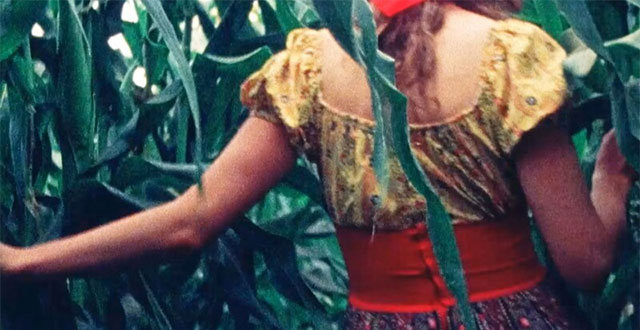
he Walker Art Center will preserve Kathleen Laughlin’s Susan Through Corn (1974), a lyrical short that follows the filmmaker’s sister, Susan, through the cornfields of St. Paul, Minnesota, in what Amos Vogel described as “an original vision, of summer, youth, a moment.” With a background in visual arts and animation, Laughlin was an integral part of the Twin Cities’ independent filmmaking community, contributing as both a teacher and graphic designer at Film in the Cities, the region’s landmark media arts center. In 2024, the Walker Art Center received an Avant-Garde Masters grant to preserve Laughlin’s earlier film Opening/Closing (1972).
Eight films by Michael Mideke will be preserved by Anthology Film Archives, marking an overdue rediscovery of a filmmaker once described as “one of the truly unknown geniuses of black-and-white filmmaking.” Though highly regarded by his contemporaries, Mideke’s work disappeared from distribution after he shifted focus away from filmmaking. His films reveal a deep fascination with the texture and physicality of celluloid, as seen in Scratch Dance (1972), a hypnotic composition of hand-scratched black leader layered through fades and superimpositions, and Phi Textures (1975), an exploration of film grain and the "Phi Phenomenon"—the illusion of motion from static images. Mideke frequently incorporated organic materials like plants and leaves, printing them directly onto film in works such as Shadow Game (1964), Twig (1966), and Flight of Shadows (1973), each of which emphasizes the tactile and ephemeral qualities of nature and film alike. Anthology Film Archives is excited to preserve and reintroduce Mideke’s visionary body of work to contemporary audiences.
Now in its twenty-third year, the Avant-Garde Masters program, created by The Film Foundation and the NFPF, has helped 34 organizations save 251 films significant to the development of the avant-garde in America. Funding for the program is generously provided by the Hobson/Lucas Family Foundation. The grants have preserved works by 92 artists, including Kenneth Anger, Shirley Clarke, Bruce Conner, Joseph Cornell, Oskar Fischinger, Hollis Frampton, Barbara Hammer, Marjorie Keller, George and Mike Kuchar, and Stan VanDerBeek. Click here to learn more about all the films preserved through the Avant-Garde Masters Grants.