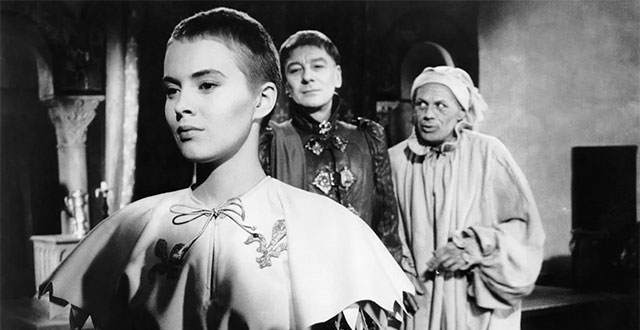
Once Maligned, Now Restored, Otto Preminger’s ‘Saint Joan’ Returns to Its Original Glory
Jim Hemphill 02/27/2026A new restoration undertaken by the Academy Film Archive and Martin Scorsese's Film Foundation will screen this weekend at the 12th annual Cinema Revival Film Festival.
This weekend the Wexner Center in Columbus, Ohio is holding its 12th annual Cinema Revival Film Festival devoted to celebrating the art and practice of film restoration and preservation. As always, the lineup is stacked with recent restorations of classics from around the globe, from New Hollywood favorites like Bob Rafelson‘s “Five Easy Pieces” and Steven Spielberg‘s “Close Encounters of the Third Kind” to Erich von Stroheim’s long lost silent treasure “Queen Kelly” and Leobardo López Arretche’s landmark 1968 documentary “El Grito.” There’s also a program devoted to animation treasures, a rare 3D screening of the Jerry Lewis comedy “Money From Home,” and a presentation of “Ghost in the Shell” director Mamoru Oshii’s live-action debut “The Red Spectacles.”
One of the best films screening at this year’s festival is also one that was seriously underrated and misunderstood by both the critics and the public when it first appeared in 1957. “Saint Joan” was producer-director Otto Preminger‘s adaptation of George Bernard Shaw’s 1923 play about the life of Joan of Arc, a play the extremely well-read Preminger considered to be “the greatest masterpiece ever written for the theater.” To adapt the play, Preminger hired the great screenwriter and novelist Graham Greene, who Preminger felt would add meaning and emotional investment to the project given his Catholicism.
“Saint Joan” had long been an object of fascination and desire for Preminger, who was in a position to acquire it after finding success as an independent filmmaker with movies like “The Moon is Blue” and “The Man With the Golden Arm” in the years following his era at Fox as a sturdy contract director. A study in opposing values that pits Joan’s unwavering faith against men in power who range from the sympathetic to the willfully ignorant, “Saint Joan” was both a departure for Preminger in its abstraction (he was already moving toward the kind of realist-based location shooting that would characterize his best films like “Anatomy of a Murder” and “Advise and Consent”) and perfectly in his wheelhouse as an exploration of moral gray areas.
To find his leading lady, Preminger embarked on a nationwide search and personally auditioned thousands of would-be Joans before landing on Jean Seberg, an 18-year old from Iowa whose acting experience was limited to high school plays. Casting the unknown Seberg, who would become exalted by cinephiles for her role in Jean-Luc Godard’s “Breathless” (as well as her performance in Preminger’s next film, “Bonjour Tristesse”), had several benefits for Preminger.
The first was a bonanza of free publicity, as the American press ate up Seberg’s Cinderella story and covered it relentlessly in the months leading up to the film’s release. The second benefit was an aesthetic one: casting a young and inexperienced American opposite mostly established British thespians (Preminger produced the film in England under the Eady plan, which provided government subsidies for films using British artists) added to Joan’s sense of isolation, oppression, and exclusion.

That alienation was increased by Preminger’s treatment of Seberg on set, which was, by all first-hand accounts, extremely harsh. Costars like Richard Widmark, who gives one of the weirdest but most interesting performances of his career as The Dauphin, were deeply troubled by Preminger’s constant verbal abuse of Seberg; then there was an accident on set (which seems to have horrified even the tyrannical Preminger) that led to Seberg getting badly burned during the climax where she is burned at the stake.
Seberg suffered through it all only to be excoriated by the press, along with Preminger, when “Saint Joan” was released. As is so often the case, there was a backlash against all the pre-release hype; the free publicity generated by Preminger’s talent search had turned rancid by the time the film finally arrived. The reviews were cruel, and extremely unfair given that Seberg’s performance is not only not the disaster the critics claimed it to be, it’s one that often rises to the level of greatness in Seberg’s ability to convey Joan’s blinding, relentless sense of commitment to her cause — and her genuine shock and horror when she learns it is not enough to spare her.
The deep sadness of Seberg’s performance, which probably feels more resonant now knowing how tragically her life ended, is unblinkingly captured by Preminger’s objective camera and cutting, which rarely editorialize. Preminger was the least manipulative of all classical Hollywood directors (one reason why he probably thrived as an independent once he broke free of the more rigid visual language directors needed to practice while under contract to the studios), a filmmaker who avoided close-ups and who kept dramatic emphasis to a minimum in his editing.
The technique was inextricably bound to his worldview as a prober and philosopher uncommitted to absolute truth or inflexible morality; in Preminger’s world, there are always myriad perspectives that, if not equally valid, are equally considered. Thus even Joan of Arc doesn’t get the heroic treatment she would if “Saint Joan” had been directed by someone like Cecil B. DeMille, or even John Ford or Michael Curtiz. Preminger’s restraint has made the film age well, but in its time it probably kept audiences from recognizing the power of Seberg’s work and the audacity of Preminger’s experimental storytelling.

The restoration of “Saint Joan” that will be screening at Cinema Revival this Sunday has been making the rounds of festivals and museums since making its world premiere at the Academy Museum a little over a year ago, and it’s a revelation for those of us who fell in love with the film via the murky home video copies that have been circulating since the early 1990s. Even Cassie Blake, the film preservationist at the Academy Film Archive who oversaw the restoration, was surprised by the film’s elegance and beauty.
“The cinematography and production design are stunning and lush in a way I had not realized until working on the restoration, despite having seen the film before,” Blake told IndieWire. “Much of the discussion surrounding the film focuses on its performances, but it’s worth paying attention to the aesthetic details as well.” Perhaps the most valuable effect of the restoration is to see how Preminger’s aesthetic concerns intersect with Seberg’s performance for maximum impact; his framing of her most exhausted, pleading moments makes “Saint Joan” as much a documentary of its lead actor’s exasperation as a biography of Joan of Arc, and the details in her expressions and gestures are more deeply, vividly felt in the 4K restoration.
Blake attributes the exquisite quality of the restoration to the superior source elements she had to work with, as the Academy possesses the original negative and optical soundtrack for “Saint Joan” as part of the Preminger Collection that Otto Preminger’s daughter Victoria donated to the archive in 2006. “Both were in beautiful condition for their age, free of any major deterioration or missing footage,” Blake said. “A restoration is often only as good as its source element, and the negative of ‘Saint Joan’ was up for the task.”
For the Academy’s restoration, the original 35mm picture negative was scanned at 4k and digitally restored in a 4k workflow. “A new 35mm track positive was produced from the 35mm optical track negative in order to provide optimal sound quality,” Blake said. “Once created, the new track positive was subsequently captured and restored. Once the digital restoration was complete, we recorded a 35mm filmout and new track negative. An answer print and release prints were created photochemically, rounding out the restoration process.”
The new print and DCP of “Saint Joan” take their place in the Academy’s archive alongside many other important Preminger prints donated by Victoria, who was a strong advocate for the restoration of “Saint Joan” before she passed away in 2024. Blake notes that the Academy also holds a rare 35mm print of the film’s trailer, in which Preminger appears and announces the selection of Seberg in the title role. “Watching the director announce his quest to find his next star cements the idea that Seberg was truly plucked from obscurity to carry this film,” Blake said. “As someone who deeply appreciates Seberg’s subsequent work in ‘Breathless’ and ‘Bonjour Tristesse,’ it’s fascinating to watch these significant facets of her trajectory.”
“Saint Joan” will screen at the Wexner Center’s Cinema Revival Film Festival on Sunday, March 1. It was restored by the Academy Film Archive and The Film Foundation, with funding provided by the Hobson/Lucas Family Foundation.
IndieWire