News
Scorsese’s Film Foundation Preserving Lifetime of Movies
Raeanne Marsh
“The future of film itself was at stake. The celluloid reels, whether catalogued in storehouses or gathering dust in an attic corner, were succumbing to the ravages of age. Against the forces of nature-and corporate indifference-Martin Scorsese began deploying his own forces: the not-inconsiderable weight of his own name and a prestigious starting cast of Woody Allen, Francis Ford Coppola, Stanley Kubrick, George Lucas, Sydney Pollack, Robert Redford and Steven Spielberg.”
“There was no system in place or incentive to make sure films would be around in the future. Now, with 545 restored films to The Film Foundation’s credit since he founded the organization dedicated to that purpose in 1990, Scorsese remains passionate about the continuing need for film restoration. In addition to the narrative feature films “we all respond to,” he says, there are “avant-garde films that are deeply compelling and can change the way you look at cinema. Or the earliest silent films that show everyday events and remind us how life has-and hasn’t-changed in over 100 years. There are documentaries, newsreels, home movies that can show the spectrum of human experience and open our eyes to moments and events from the past in a most powerful way.”
“Scorsese, as a young filmmaker, had been inspired by the old RKO films and others from the past. But he noticed that the prints he say, whether from a library or a studio, were pink; the colors were faded. He spearheaded a campaign for Kodak to develop a low-fade stock so the color would be more stable, advocating for it during his press tour in 1980 for “Raging Bull”-which he shot in black-and-white specifically so as not to be worried about it fading 10 years down the line.”
“The board (The Film Foundation) helps select the preservation projects the foundation will fund, based on historical and technical significance such as a director’s first use of color, a specific color process or wide screen. Explains Scorsese, “The archives send in a proposal each year, outlining and prioritizing the films most in need of preservation, and the board reviews the titles and proposals, the materials available and the additional information on the cultural and historical significance of the pictures provided by the archives. And then we decide.”
“Two years after launching The Story of Movies, TFF grew in another direction: It consolidated with Artists Rights Foundation, whose mission paralleled TFF’s. ARF’s focus on protecting the films’ creative elements over issues such as colorization and unauthorized editing underscores concerns that restorers constantly grapple with: Using today’s advanced technology to make something look as good as it can without adding one’s own aesthetic.”
“Choices inform the look of the final product. Archivists and TFF’s board study films and look at reference prints (and, in ever more rare cases, even talk to the director) to know what a director may have been going for in his body of work or specific film.”
“John Huston and cinematographer Oswald Morris used a subdued color palette that was almost sepia, even though it was done with the three-strip [Technicolor] process.”
“Three-strip Technicolor films used three different cameras, each creating a color record for the red, blue or yellow section of the color chart. Digital technology enables the color records to be aligned exactly, which give Technicolor a new look. ‘The original was a soft look,’ says Bodde (Margaret Bodde executive Director of TFF), ‘but did the director want that, or would he have wanted a sharp look?”
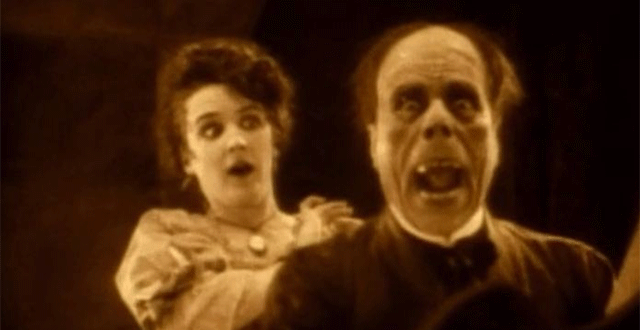
“Using “The Phantom of the Opera” as an example-it was shot in black-and-white but has one sequence featuring Lon Chaney wearing a brilliant red cloak-Jackson describes the dilemma of leaving the color in the “rather crude, hand-painted-look, two-color process of the time” or improving the appearance and making it more perfect.”
“Assume nobody’s an expert,” he says. “[Offer] the view of how audiences would have seen ‘Phantom of the Opera’ in 1925 and how it would have looked if [the director] would have had access to our technology. …The capacity on discs is such that there’s no reason you can’t offer both versions at no extra cost.” And he adds, “It wold inspire interest, and may make some young viewer into a future historian.”
HFPA Brings Total of Grants to Over $12 Million
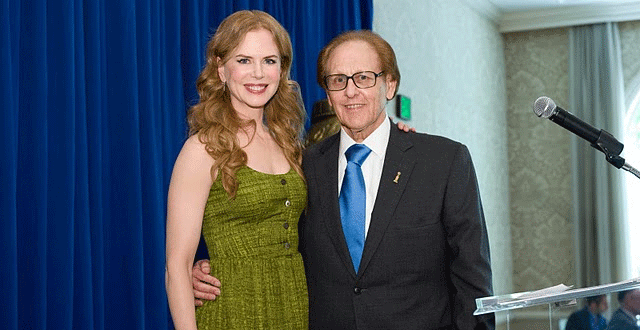
Nicole Kidman stopped off at the Four Seasons Hotel in Beverly Hills on her way home to Nashville to accept a check for $350,000 on behalf of the Film Foundation from the Hollywood Foreign Press Association.
The donation was among more than $1.5 million dollars given by the association this year to various charities, bringing the total amount of its grants to more than $12 million.
Association president Philip Berk introduced the event’s host, Desperate Housewives star Eva Longoria, who said that the grant to the Film Foundation, the non-profit organization founded 20 years ago by Academy Award winning director Martin Scorsese, would go towards renovating and preserving the 1933 classic movie King Kong, Michael Cortiz’s 1959 movie The Breaking Point, Elia Kazan’s 1963 America, America and several silent Alfred Hitchcock movies.
Other grants, accepted by Annette Bening, Bryan Cranston, Kaley Cuoco, Matthew Fox, Ryan Philippe, John Slattery and Aaron Solkin, included $110,000 to UCLA; $60,000 to California Institute for the Arts; and $50,000 each to Columbia University; California State University, Long Beach; California State University, Los Angeles; and California State University Northridge.
Scorsese Restores “The Leopard” and Revives Cannes’s Golden Age
Julian Sancton
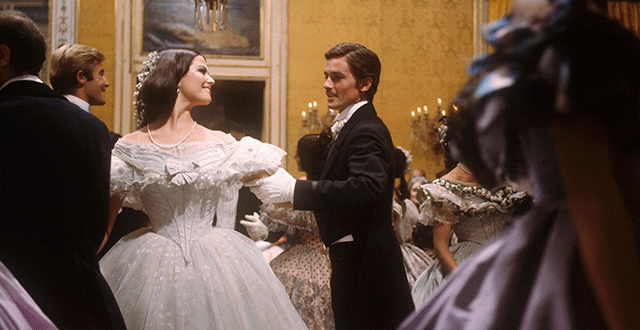
Burt Lancaster in Luchino Visconti's Il Gattopardo, before and after restoration.
A common refrain at Cannes is that the films, the stars, and the glamour ain't what they used to be. This is disheartening to a relative newcomer to the festival.
How far back in time does one have to travel to get a taste of Cannes in its prime? Is it 2001, when George Clooney and Brad Pitt walked up the steps of the Palais together for Ocean's Eleven? Or 1976, at the height of the auteur period, when Martin Scorsese won the Palme d'Or for Taxi Driver? Or 1960, when the prize went to La Dolce Vita? Certainly there were fewer film bloggers then.
The answer is: last night. Scorsese brought the past to us in full Technirama glory with a pristine restoration of Luchino Visconti's masterpiece, Il Gattopardo (The Leopard), 1963's Palme d'Or winner. Le tout Cannes assembled at the Debussy theater for the screening. Here were jury members Benicio Del Toro and Kate Beckinsale. There was festival darling Juliette Binoche. Salma Hayek accompanied her billionaire husband, Francois-Henri Pinault, who runs Gucci, a partner in the restoration effort by Scorsese's Film Foundation. Also in attendance were the film's two stars, Alain Delon and Claudia Cardinale, both fixtures of Cannes's golden age. The congregation waited for more than a half hour as Scorsese made his way, accompanied by Gucci designer Frida Giannini, through blocked Croisette traffic, and up the red-carpeted steps past paparazzi and the black-tie beau monde streaming into the Wall Street premiere. When he did arrive, his messianic aura rippled through the room, necks swiveled, and awestruck French film geeks shouted, "Fuck, it's Scorsese!"
"I live with this movie every day of my life," the director said when presenting Il Gattopardo, an epic adaptation of Giuseppe de Lampedusa's novel about an aristocratic Sicilian family's adjustment to a changing way of life during the Risorgimento. (It's Italy's Gone With the Wind.) Scorsese rhapsodized about the film's "deeply measured tone ... its use of vast spaces and also the richness of every detail."
As with every image printed onto celluloid, that richness and that detail—like the old aristocratic way of life, and like the glamour of Cannes' heyday—has faded over time. In the film, Prince Don Fabrizio Salina (a dubbed Burt Lancaster) says, "In order for everything to stay the same, everything must change." The line aptly describes the process of film restoration, which in this case involved 12,000 hours of work to transfer the 35 mm prints to a digital format, painstakingly remove 47 years' worth of dirt and scratches, and give the color a blood transfusion. The result is sublime, as close as possible to watching the film's first projection.
The colors are never more resplendent than in the sumptuous ballroom scene that makes up the last third the three-hour movie, from the deep red of the lobsters to the shimmering gold leaf, to the pastel hues of the gowns, and the, well, ochre of the chamber pots. Watching themselves waltzing onscreen, as one of the most beautiful couples in film history, Delon and Cardinale—now 75 and 72, respectively—grabbed each other's hands. After the screening, Delon, still dashing with a full head of white, longish hair (and from what I hear from a female audience member last night, still helplessly flirtatious), and Cardinale, elastic as a 20-year-old starlet, soaked in the audience's adulation as if they had just performed the film on stage. Visibly enamored, Scorsese, shorter than Cardinale by a few inches, stretched to kiss her on both cheeks.
Scorsese later stopped by at the after-party at the enchanting Eden Roc hotel, where Vanity Fair will host its party tonight.
Gucci Helps Scorsese Restore ‘The Leopard’
Steve Pond
$900,000 grant to Film Foundation helps with 4K digital restoration of Visconti’s 1963 Palme d’Or winner
When the newly-restored version of Luchino Visconti’s “Il Gattopardo” (“The Leopard”) premieres at Cannes on Friday, viewers will have Martin Scorsese’s Film Foundation to thank for the restoration done to the 1963 Palme d’Or winner.
But they’ll also have to thank the Italian fashion house Gucci, which donated $900,000 to Scorsese’s foundation to help restore that film, as well as to do upcoming work on Federico Fellini’s 1960 classic “La Dolce Vita.”
Over the years, Gucci has donated $1.5 million to the Film Foundation for the restoration of six classic films, including John Cassavetes’ “A Woman Under the Influence,” Michaelangelo Antonioni’s “Le Amiche,” Barbara Loden’s “Wanda” and Visconti’s “Senso.”
The 4K digital restoration of “Il Gattopardo” was done at Sony’s Colorworks Digital Facility through a partnership of several firms: Cineteca di Bologna, L’Immagine Ritrovata, The Film Foundation, Pathé, Fondation Jérôme Seydoux-Pathé, Twentieth Century Fox, and Centro Sperimentale di Cinematografia-Cineteca Nazionale.
The night after the restored film’s unveiling, Gucci’s creative director, Frida Giannini, and Vanity Fair editor Graydon Carter will host a dinner and party in honor of Scorsese and the Film Foundation’s 20th anniversary.