News
PRESERVATIONISTS GIVE FLICKER OF HOPE TO ENDANGERED FILMS
Terry Mikesell
With its next series, the Wexner Center for the Arts will celebrate the rescue of the odd and the unusual.
“Avant-Garde Masters: A Decade of Preservation” will begin tonight with a series of short films introduced by Jeff Lambert, assistant director of the National Film Preservation Foundation in San Francisco.
According to the Film Foundation, which is dedicated to movie preservation and restoration, half of all American movies made before 1950, and more than 90 percent of films made before 1929, are lost.
Want to see The Way of All Flesh, the 1927 movie for which Emil Jannings won the first best-actor Academy Award? You can’t; the film is considered to be lost. The UCLA Film and Television Archive has a five-minute snippet of footage.
One of the culprits is the nitrate film stock that, before 1950, was the industry standard. Nitrate film easily decomposed and, even worse, was flammable. Acetate film, which replaced nitrate, tended to fade. Not until more-stable polyester film was created in the 1990s did the problem lessen.
Plus, before the secondary home-viewing market took off, out-of-circulation movies were often treated like old magazines and discarded.
“The nitrate film was expensive to ship and dangerous,” Lambert said in a phone interview. “At the end of its run, there were often instructions to just dispose of the prints. Luckily, there were projectionists and other people who held on to them.”
Hollywood has gotten behind the preservation effort. In 1990, director Martin Scorsese created the Film Foundation, which has salvaged more than 560 movies.
In 1992, Congress became involved by asking the Library of Congress to study film conservation. The resulting report led to the creation of the National Film Preservation Foundation.
“The mandate of the Film Preservation Foundation is to deal with the non-Hollywood films: home movies, industrial films, documentaries, educational films, travelogues,” Lambert said, “things that wouldn’t survive without public support, because there’s no market incentive.
“But they’re of immense historical interest — home movies by an African-American porter on a train from the 1950s. It’s very unique to get his point of view.”
Lambert was inspired to work in preservation as a student at San Francisco State University. There, he took a film-history class taught by Scott Simmon, a film scholar who had helped restore the single surviving copy of a 1920 Spanish movie.
“It was through his film-history class that my eyes were opened to the way that film preservation could help fill gaps in film history,” Lambert said in a subsequent email.
And he takes a glass-half-full approach to the statistics on the number of films lost.
“While . . . (the figures mentioned) seem discouraging, I’ve learned to take an optimist’s approach,” he wrote. “Instead of bemoaning what we think is lost, better to think of all the discoveries there are to uncover.”
Among the restored works to be screened at the Wexner are avante-garde films such as Cosmic Ray (Bruce Conner, 4 minutes, 1961), Prefaces (Abigail Child, 10 minutes, 1981), Rabbit’s Moon (Kenneth Anger, 16 minutes, 1950), and The Velvet Underground in Boston (Andy Warhol, 33 minutes, 1967).
On Wednesday, a tribute to the filmmaking Kuchar brothers will take place.Experimental filmmaking is near and dear to Lambert, who produced the DVD set Treasures IV: American Avant-Garde, 1947-1986 and is curating the foundation’s next set, Treasures 6: Next Wave Avant-Garde, due for release in 2013.
“There’s a certain freedom that the filmmakers take, the artists take,” he said. “It forces audiences to look at film in a different way than what they’re used to.
“When you come out of an avante-garde, you look at the world differently.”

CLASSIC HOLLYWOOD: ALFRED HITCHCOCK'S 'THE RING' SHOWS AT ACADEMY
Susan King
Alfred Hitchcock's restored silent film 'The Ring' screens at the academy's Samuel Goldwyn Theater.
With his acute sense of irony and the macabre, Alfred Hitchcock would appreciate the fact that he's one of the hottest directors in the world even though he's been dead for 32 years.
Fans and critics have always been fascinated with the Master of Suspense, who directed such seminal films as 1940's "Rebecca," 1945's "Spellbound," 1946's "Notorious," 1954's "Rear Window," 1960's "Psycho" and 1963's "The Birds." But 2012 has been an exceptional year in the Hitchcock legacy.
For decades, the British Film Institute's periodical Sight and Sound's poll of critics named Orson Welles' 1941 masterwork "Citizen Kane" the best movie ever made. Then this summer, Hitchcock's 1958 psychological thriller "Vertigo" nudged "Kane" out of the top spot.
He's also the subject of two movies — HBO's "The Girl," which premiered in October, examining his Svengali relationship with actress Tippi Hedren during the making of "The Birds," and the just-released feature "Hitchcock," which chronicles the production of "Psycho" and his marriage to screenwriter Alma Reville.
Even before this recent hoopla, the British Film Institute unveiled its restoration of the 1927 Hitchcock silent film "The Ring" at the Cannes Film Festival in May "where it was received incredibly well," said Ellen Harrington, programmer at the Academy of Motion Picture Arts and Sciences. The restored "The Ring" will have its U.S. premiere Thursday at 7:30 p.m. at the academy's Samuel Goldwyn Theater.
The digital presentation will feature a new score by British jazz and hip-hop musician Soweto Kinch and the Soweto Kinch Septet which was composed and performed for the film's screening this summer at the London 2012 Festival. The film is part of the BFI's "Rescue the Hitchcock 9" project to digitally restore the nine surviving Hitchcock silent movies.
"It's probably the most extensive program that we have done," said Robin Baker, head curator of the BFI National Archive.
The only one missing from the list is 1926's "The Mountain Eagle," a melodrama Hitchcock later disparaged. "It seems to have been lost since the late 1920s," said Baker.
The BFI had received the original nitrate negative of "The Ring" in 1959. "When it came to us, it wasn't in great condition," said Baker. When the BFI made a copy of the damaged negative, all the inherent problems in the original were printed in the copy.
To make matters worse, the copying process "wasn't done as well it could have been. There were all kinds of blurring within the image in how it was printed. So we had real problems," Baker noted. "What we have managed to do in terms of stabilizing the picture, I still can't believe it."
Hitchcock scored a huge hit in 1927 with "The Lodger," an evocative thriller about a serial killer terrorizing women in London, where he began work on "The Ring." "The Ring" though is not a suspense thriller, but a melodrama about two boxers who are in love with the same woman. It is the only one of Hitchcock's films on which he has sole writing credit.
Carl Brisson stars as "One Round" Jack, a boxer working in a carnival show who loses a bout to Australian champion Bob Corby (Ian Hunter). Jack also finds himself losing his girlfriend Mabel (Lillian Hall-Davis) to Bob. Though not the archetype "Hitchcock blond," Mabel is a coolly manipulative woman who doesn't hide her flirtations with Bob from Jack even after they marry.
"He was legitimately fascinated with boxing in his personal life," said Harrington. "There was a famous boxer named Albert Hall who appears in the film. Hitchcock had gone to see his championship bouts."
Though there are many sophisticated visual touches in the film — Hitchcock would return to the carnival milieu in 1942's "Saboteur" and 1951's "Strangers on a Train" — "it's very much not a Hitchcock movie," said UCLA Film and Television archive head Jan-Christopher Horak, who described it as an "English film melodrama."
"In other words, it is one of those films like his 'The Farmer's Wife,' which is made right around the same time," Horak said. "It is cut together well, the acting is fine, but it has not what we consider Hitchcock in terms of his themes and obsessions. I don't think he had found his voice yet."
Principal restoration funding provided by The Hollywood Foreign Press Association and The Film Foundation. Additional funding provided by Deluxe 142 and The Mohamed S. Farsi Foundation.
ONCE UPON A TIME IN CANNES
Martin Scorsese
When Sergio Leone made Once Upon a Time in America, it was an event. Here was the man who had invented the spaghetti Western, coming to New York to make a Jewish gangster epic. Everybody, including my friends Bob De Niro and Joe Pesci, was in it; everybody in New York was working on it. We all knew it would be unlike anything we’d ever seen.
The version released in the summer of 1984 pleased no one, Leone least of all. The much longer cut that came out later that year restored his extraordinary Proustian structure, but it was missing 40 minutes that Leone felt to be crucial to his grand, 20th-century canvas.
Recently, with the help of the Leone family, 25 minutes of material was found, including an extended excerpt from Antony and Cleopatra, featuring Elizabeth McGovern, and a long-rumored exchange between De Niro and Louise Fletcher. These scenes and others have now been re-inserted into the picture, and the restoration—a collaboration involving the Cineteca di Bologna, L’Immagine Ritrovata, and the Film Foundation, with funding from Gucci—is nearly complete.
A great film just became that much greater.
-- Martin Scorsese
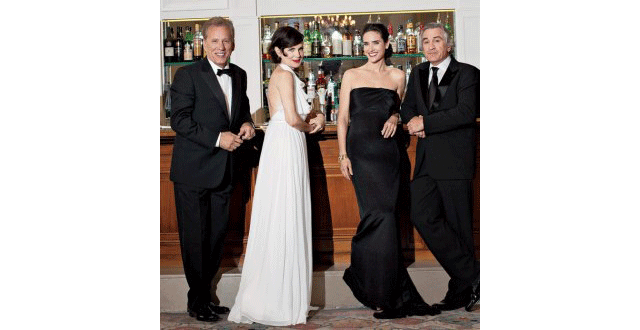
Photograph by Brigitte Lacombe - James Woods, Elizabeth McGovern, Jennifer Connelly, and Robert De Niro, original cast members of Once upon a Time in America, photographed at the bar of the Hôtel du Cap-Eden-Roc, Cap d’Antibes, France.
The Breaking Point Screens at L.A. Film Festival on Saturday
Susan King
"The Breaking Point” is one of those forgotten great films that you have probably never heard of, let alone seen. But over the last decade, the 1950 film noir based on Ernest Hemingway’s “To Have and Have Not” is getting the respect it so richly deserved. Last year, Warner Archive released the film on DVD, and Saturday afternoon the Los Angeles Film Festival will screen the recently restored print at REDCAT.
“I think it is the best adaptation of any of Hemingway’s works,” said film noir historian Alan K. Rode. “In fact, Hemingway told Patricia Neal, who was in the movie, that this was [his favorite] movie made of any of his books.”
Warner Bros, the studio that produced “The Breaking Point,” had scored a huge hit with its very loose 1944 adaptation of “To Have and Have Not,” which starred Humphrey Bogart and Lauren Bacall. The only thing that movie and Hemingway’s story of a married fishing boat captain on the ropes had in common was the title and the name of the lead character, Harry Morgan.
Directed by Howard Hawks, the fun and romantic “To Have and Have Not” involved Nazis, the French Resistance and a lot of quips between Bogart and Bacall, who married the following year.
“The Breaking Point,” said Rode, was the brainchild of writer Ranald MacDougall, who sold the idea of doing a more faithful adaptation of Hemingway's book to Warner Bros.’ producer Jerry Wald. The project also served as the return of actor John Garfield to Warner Bros.
Garfield had become a star at Warner Bros. in 1938 with “Four Daughters” and was one of the studio’s top talents until he left to form his own production company, which made one hit film, the 1947 classic boxing drama, “Body and Soul.” But his career was treading water after that.
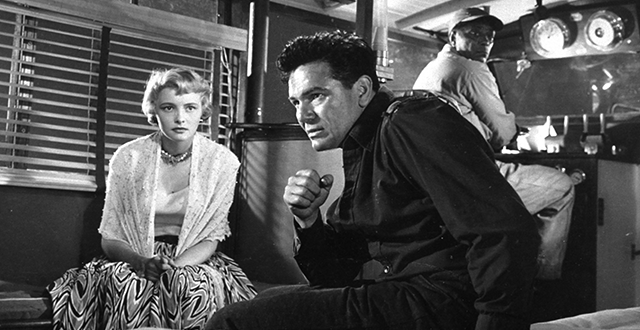
“The Breaking Point” was to be his first film of a two-picture deal with the studio. And Oscar winner Michael Curtiz of “Casablanca” fame, who had directed Garfield in “Four Daughters” and other films, came on board. Neal played the femme fatale, Phyllis Thaxter was Garfield’s loving wife and Juano Hernandez played his co-worker and friend.
Harry Morgan is a hard-working fisherman for hire who can barely make ends meet. “I would call this a mid-life crisis noir," Rode said. “I think one of the reasons why the movie holds up, and why so many film noir movies hold up, is that people can identify with him. He is losing his boat. He loves his wife. He loves his children. But so often as we see in film noir, people get on that trolley car and they ride it to the end.
"Garfield gets involved with a very shady lawyer and in immigrant smuggling and much, much more. Pat Neal tempts Garfield and gets him right to the point he is going to get involved with her, but his innate character keeps calling him back. So much of it rings true.”
Warner Bros. planned to give “The Breaking Point” a huge buildup leading to its release in early October. But during the summer of that year, “Red Channels,” a pamphlet that named actors, writers, musicians, broadcast journalists and others who were considered Communist or had Communist leanings or knew “subversives,” came out.
Though he was not political, Garfield’s wife was, and his name was on the list.
"All the movie moguls were scared, and none were more scared ... of the hysterical atmosphere of anti-communism than Jack L. Warner," noted Rode. "He completely pulled the plug on the movie and put almost no money into promotion. The picture was released, got good reviews and it was absolutely buried. Garfield’s contract for another picture was canceled by Jack Warner.”
Garfield would make one more picture, 1951’s “He Ran All the Way,” before he died of a heart attack in 1952 at the age of 39.
Martin Scorsese’s the Film Foundation is sponsoring “The Breaking Point” at LAFF. Funding for the restoration was provided by Warner Bros. in association with the foundation and theHollywood Foreign Press Assn. UCLA Film & Television Archive did the preservation and restoration.
“One of the great things about preservation in general is if you have never seen a movie, it doesn’t matter if it’s 60 years old, it’s a new movie to you,” said Margaret Bodde, executive director of the Film Foundation. “So preservation is this wonderful resource for everyone discovering a film for the first time.”