News
THE CURRENT STATE OF FILM PRESERVATION
Martin Scorsese
In this past decade we have witnessed a growing awareness of film preservation. However, the deterioration and eventual disappearance of films have not come to an end. We're still racing against the clock to save what we can.
There are two areas of film preservation that each have their own unique problems. The first is the film libraries owned by the studios, which represent the majority of American films. The second area is orphaned films — meaning films in the public domain or owned by small companies that have no money for restoration; this also includes documentaries, newsreels, independent features, shorts and avantgarde films. In both areas, many of these titles have to be transferred from nitrate to safety stock — 100 million feet to be exact.
Regarding the studio libraries, there has been substantial progress — to different extent.
Regarding orphan films, the problem is overwhelming. Just the cataloguing is a daunting task. This is the area where major losses have already occurred and continue to occur every day. Whereas it was relatively simple for The Film Foundation to help build a bridge between the studios and archives, with orphan films there is nothing to build a bridge to — when work happens at all, it happens at random, by chance or by luck.
The National Film Registry has been valuable in the recognition of film as a vital part of our cultural heritage. However, the challenge in our country is so large and so costly that it requires a unique partnership bringing together resources from many different areas — the private sector as well as public and government institutions. Each area has its contribution to make, but no one can get the job done alone.
It is important to emphasize that the best case of all for preservation is made when films are seen and appreciated by audiences. Screening preserved films serves as a reminder of a precious and vital part of our culture.
During these last few decades, technology has evolved in unforeseen ways. In the 1960s, film libraries were thought to have no value whatsoever — they were just a storage expense. Just consider how the situation has changed.
We foresee a future in which technologies will bring a new cinema, born out of those technologies. Perhaps cinema as we have known it in these past one hundred years will really become a part of the past. If so, that is one more reason to save what we have and, most of all, to preserve the negatives as an irreplaceable source.
The Film Foundation will continue to work with the studios and support joint projects studio-archives.
It will also support a proposed mechanism called The National Plan, spearheaded by the Library of Congress, which would call for a dollar-for-dollar match of contributions from the government and private sectors to preserve orphan films.
Films of the past are alive as part of our own creative work in the present. As Peter Bogdanovich said recently, "There are no old movies, but movies I have seen and movies that I haven't seen."
PRESS RELEASE: FILMMAKERS ANNOUNCE NEW FILM FOUNDATION FOR FILM PRESERVATION
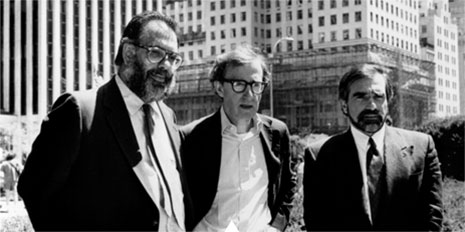
Beverly Hills (May 1, 1990) — Film directors Martin Scorsese, Woody Allen, Francis Ford Coppola, Stanley Kubrick, George Lucas, Sydney Pollack, Robert Redford, and Steven Spielberg announced today the formation of The Film Foundation, dedicated to ensuring the survival of the American film heritage.
At a news conference at Creative Artists Agency in Beverly Hills, Martin Scorsese, President of the new foundation's Board of Directors noted, "When filmmakers in the 21st century ask what was done to preserve the pictures made in this century, they will look to us. As friends and colleagues who have been concerned about film preservation for many years, we have come together now as filmmakers to assure that fifty years from now, we'll be able to give an affirmative answer to our successors." Scorsese was joined at the news conference by fellow founding members George Lucas, Sydney Pollack, and Steven Spielberg.
Allen, Coppola, Kubrick, Lucas, Pollack, Redford, Scorsese, and Spielberg have each been involved as individuals in the film preservation cause in the past. With The Film Foundation, they have joined together to work as creative artists dedicated to the principle that as filmmakers, they have a special responsibility both to the work of the past masters of their art and to the motion pictures which they and their peers are creating today.
The Film Foundation has four primary goals. In all of its activities it will foster a greater awareness with the general public of the urgent need to preserve motion picture history; second, the foundation will work with the archives to raise funds for preservation; third, the foundation will encourage cooperative preservation projects, bringing together the archives and the industry; fourth, it will work to see that reliable preservation practices are in place to ensure the long life of current productions.
The foundation will be advised on the establishment of goals and policies by its Archivists Advisory Council, made up of leaders from the nation's five major film archives. Chaired by Robert Rosen from UCLA, the institutions represented on the council include the International Museum of Photography at George Eastman House, the Library of Congress, the Museum of Modern Art, the National Center for Film and Video Preservation at the AFI, and the UCLA Film and Television Archive.
The foundation will be administered by Co-Executive Directors Raffaele Donato, (Martin Scrosese's archivist), and CAA agent Jay Moloney. Serving as Secretariat to the foundation will be the National Center for Film and Video Preservation at the AFI, playing a coordinating role with the broader archival field.
The foundation has already established a number of projects it will pursue. The first of these is to encourage the creation of a Studio Preservation Fund, totaling at least $30 million for restoration projects to be undertaken jointly by the studios and the archives. The foundation has also announced an initiative on behalf of the preservation of independent films, to be spearheaded by board member Robert Redford. A third initiative, chaired by Archivists Advisory Council member Paul Spehr, will deal with guidelines for the preservation of current production.
Fifty percent of all the films made in the before 1950 have already been lost, and many more remain endangered. Says foundation Board member Steven Spielberg, "Our hope is that the partnership of the archives and the studios will ensure that our film heritage is something that we can pass on to our children."